
#CIA CIA #FBI FBI #Mossad Mossad
My opinion:
Use Google AI (Search & Gemini) for the OSINT collection, research, and analysis.LLM (Large Language Model) translates easily into the plain English, and its logic is easy to understand. And it is accessible ad max.
Using Google Search and Gemini for Open-Source Intelligence (OSINT) works best when you treat Search for broad discovery and verification, and Gemini for multi-step synthesis, parsing large datasets, and automating repeatable workflows. [1] ( gemini.google/overview/deep-…), [2] ( aware-online.com/en/what-do-…), [3] ( theaugmentedinvestigator.sub…)
1. Collection & Query Expansion
• Google Search: Use targeted search operators, date filters, and AI-powered search views to surface primary sources, mentions, and leads quickly. [1] ( youtube.com/watch?v=3p2Sze9r…)
• Keyword & Syntax Expansion with Gemini: Ask Gemini to brainstorm synonyms, regional slang, alternate spellings, and platform-specific search strings before you run broad queries. [1] ( flashpoint.io/blog/flashpoin…)
• Translation & Transcription: Feed multilingual text, screenshots, audio, or video into Gemini to translate nuances or extract key points from non-English sources. [1] ( youtube.com/watch?v=lUdyQDiZ…), [2] ( theaugmentedinvestigator.sub…)
• Automated Pipelines: For high-volume or recurring collection, Gemini API agents can query the web and run code in a sandboxed environment to parse and structure collected records. [1] ( aware-online.com/en/what-do-…)2. Deep Research & Cross-Source Synthesis
• Multi-Step Investigation: Use Gemini Deep Research when a topic needs a structured multi-step plan across dozens of web pages, PDFs, or your own files (like Drive docs or spreadsheets). You can review and adjust its research plan before it runs. [1] ( support.google.com/gemini/an…), [2] ( gemini.google/overview/deep-…), [3] ( reddit.com/r/AISEOInsider/co…)
• Large Context Windows: Gemini’s large context window lets you drop in bulky materials—such as reports, filings, transcripts, or collections of articles—and ask targeted questions across the whole set at once. [1] ( theaugmentedinvestigator.sub…)
• Threat & Security Context: For cyber and infrastructure investigations, Google Threat Intelligence pairs Mandiant intelligence with Gemini to triage signals and cut down noise. [1] ( cloud.google.com/security/pr…)3. Analysis, Verification & OPSEC
• Timeline & Entity Mapping: Have Gemini extract dates, locations, organizations, and relationships from messy notes or articles into tables or timelines so gaps and contradictions stand out.
• Verify Everything Independently: LLMs can hallucinate, mix up entities with similar names, or misread visual details. Always click through to original sources, check timestamps, and corroborate claims with primary evidence. [1] ( youtube.com/watch?v=rpEcFBnF…)
• Mind Your Footprint & Privacy: Avoid pasting sensitive target details or confidential investigation data into consumer tools if your workflow requires strict confidentiality—check account settings, logging policies, and operational security (OPSEC) rules first. For additional community workflows and templates, see the OSINT AI Guide on GitHub. [1] ( aware-online.com/en/what-do-…), [2] ( github.com/atlas-bear/osint-…)
If you have a specific investigation type—like corporate due diligence, geolocation, or threat monitoring—share what you’re looking into and I can help structure prompts or a search workflow.
SponsoredYou might consider these options:
Google LLC
Google Gemini For Analysis – Analyze Research Data
Collaborate with Google Gemini to start analyzing complex data sets and methodologies.
exa.ai
AI Search Engine – Deep Research API
The world’s fastest search API built for LLMs, agents, and research tools.x.com/mikenov/status/2125705…Michael Novakhov (@mikenov)How suitable is the Google AI, including the Search and the Gemini, for the Intelligence and counterintelligence collection and analysis? – Google Search google.com/search?num=10&new…— https://x.com/mikenov/status/2125705804078571847
— Michael Novakhov (@mikenov) Nov 25, 2026
Author: wawiimuy
Use Google AI (Search & Gemini) for the OSINT collection, research, and analysis.
LLM (Large Language Model) translates easily into the plain English, and its logic is easy to understand.
And it is accessible ad max.
x.com/mikenov/status/2125705…Michael Novakhov (@mikenov)How suitable is the Google AI, including the Search and the Gemini, for the Intelligence and counterintelligence collection and analysis? – Google Search google.com/search?num=10&new…— https://x.com/mikenov/status/2125705804078571847— Michael Novakhov (@mikenov) Nov 25, 2026
#CIA CIA #FBI FBI #Mossad Mossad
The art of asking questions: OSINT and AI – Google Search
In both open-source intelligence (OSINT) and AI workflows, better questions prevent wasted effort, reduce bias, and sharpen analysis. In OSINT, a strong question defines what to collect and why; with AI, a strong question sets boundaries, supplies context, and forces verification rather than blind trust. [1, 2, 3]
Guidance from OSINT Combine highlights how framing questions upfront drives collection, challenges assumptions, and keeps investigations focused. [1]Core Principles for OSINT Questioning
Start with intelligence requirements: Frame clear questions before collecting data so you do not drown in irrelevant open-source noise. [1, 2]
Ask for indicators, not just answers: Replace broad prompts with concrete observable indicators (such as specific threat or behavioral signs) to guide search and collection. [1, 2]
Use 5W1H to structure analysis: Break raw findings down by who, what, when, where, why, and how to spot gaps and connections. [1]
Ask what is missing: Revisit your questions as evidence appears, and ask “What are we not seeing?” to catch blind spots or synthetic/fake content. [1, 2]Core Principles for AI Questioning
Give context and constraints: State the goal, audience, scope, background facts, and output format up front. [1, 2, 3]
Stay open-ended when exploring, specific when extracting: Use open questions to brainstorm angles or challenge assumptions, and narrow questions when checking details or formatting results. [1, 2]
Iterate with follow-ups: Treat prompting as a loop—refine unclear answers, test trade-offs, and ask what information the model still needs. [1, 2, 3]
Verify every critical claim: LLMs predict patterns rather than guarantee truth or forensic repeatability, so independently check facts before acting on them. [1, 2, 3]Where OSINT and AI Overlap
Brainstorming and triage: Use AI to suggest search angles, translations, or patterns in large datasets, while keeping human analysts in charge of validation.
Operational security: Never paste sensitive, personal, or confidential investigation data into public AI tools.
Countering synthetic noise: Pair AI-assisted workflows with strict source verification to spot fabricated claims and AI-generated media. [1, 2, 3, 4, 5, 6]— Michael Novakhov (@mikenov) Nov 25, 2026
The art of asking questions: OSINT and AI – Google Search google.com/search?q=The+art+…
— Michael Novakhov (@mikenov) Nov 25, 2026
How suitable is the Google AI, including the Search and the Gemini, for the Intelligence and counterintelligence collection and analysis? – Google Search google.com/search?num=10&new…
— Michael Novakhov (@mikenov) Nov 25, 2026
Every person you’ll ever meet is mainly interested in themselves. Not most people. Every person.
It’s not cynicism. Accept it and you stop taking things personally, stop being surprised by betrayal, stop being manipulated. 🧠
Robert Greene, in 5 minutes on Deepstash.
— @deepstash Nov 25, 2026
Much of the confusion around AI search starts with Google’s own products. Ask ten people to explain the difference between Google AI Overviews, AI Mode and Gemini, and you will often get ten different answers. That confusion is understandable. The products overlap. They use the same family of Gemini
 |
Michael_Novakhov shared this story.
|
Much of the confusion around AI search starts with Google’s own products. Ask ten people to explain the difference between Google AI Overviews, AI Mode and Gemini, and you will often get ten different answers. That confusion is understandable. The products overlap. They use the same family of Gemini models. They all answer questions. But they are not the same experience, they are not used the same way, and they should not be measured the same way – and if you mix them together, it becomes much harder to understand AI-search behavior, traffic and visibility.
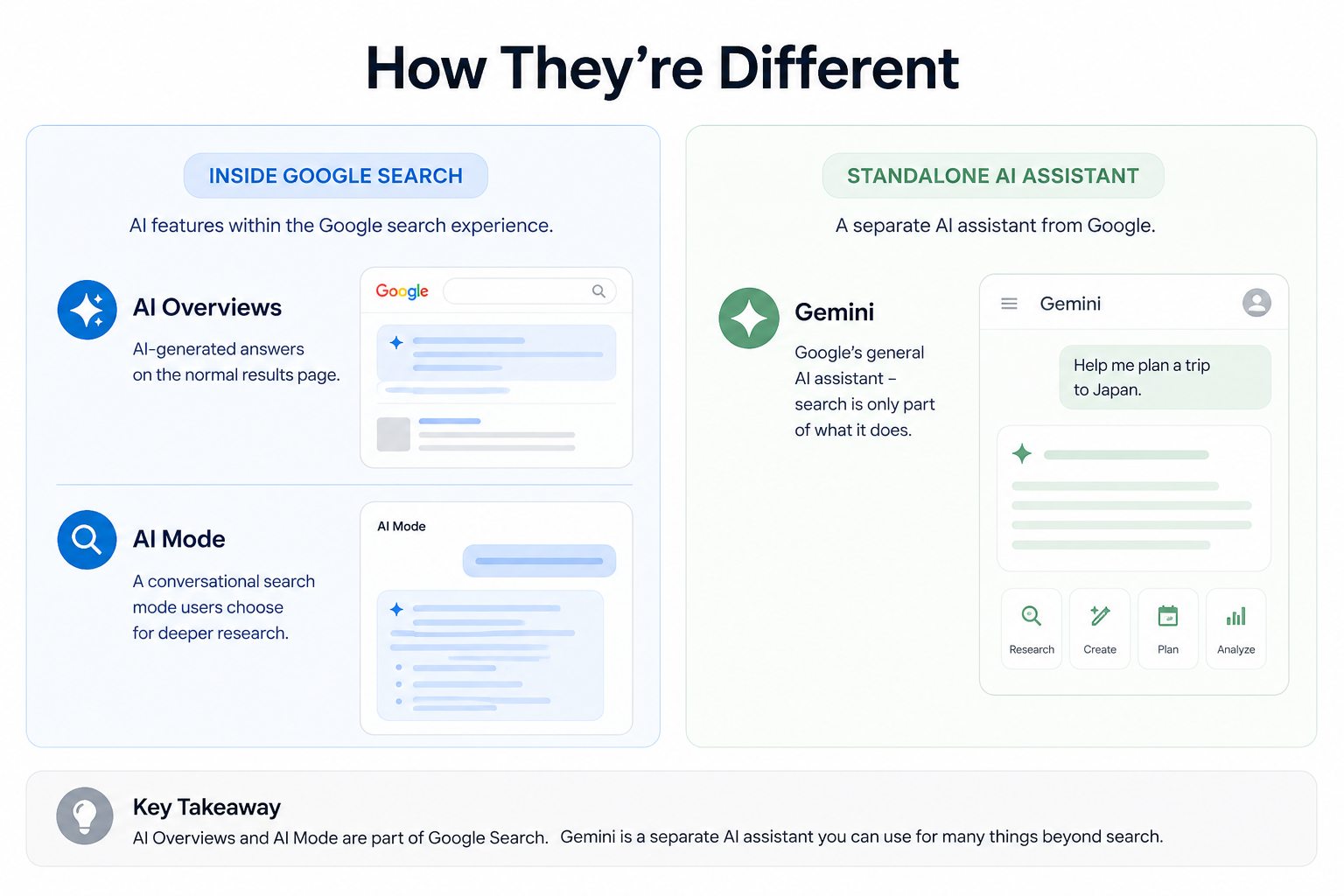
The simplest way to explain the difference
AI Overviews is an AI answer placed inside a normal Google search results page.
AI Mode is Google’s more conversational, research-oriented search experience.
Gemini is Google’s standalone general AI assistant, which can help with research but also many non-search tasks.
Our estimated monthly U.S. search-like activity
Modeled estimates, not platform-reported totals. How each was built is shown in its section below.
~64B
Google AI Overviews – U.S. searches per month showing an AI Overview
~3B
Google AI Mode – search-like prompts per month (U.S.)
~1.4B
Gemini – search-like prompts per month (U.S.)
Why the distinction matters
The difference matters because these products represent different user intents, different surfaces, and different ways information is discovered and presented.
AI Overviews
Appears in ordinary Google searches
Piggybacks on traditional Google Search volume. Users may not even consciously decide to use an AI product. They simply search on Google and receive an AI answer.
AI Mode
Users choose it for deeper research
A much clearer signal of research intent. The user is opting into a more back-and-forth experience, often for comparisons, planning or complex decisions.
Gemini
Used for search and many other tasks
Spans far more than search. It can be used for questions, but also brainstorming, writing, organizing, multimodal tasks and assistant-like help across Google surfaces.
Why this is so confusing in practice
All three products use Gemini technology, but they are different user experiences. That is why it is easy to hear that “Gemini is growing,” “AI Mode has passed 1 billion users,” and “AI Overviews reaches 2.5 billion users,” and mistakenly assume those are three versions of the same metric. They are not.
Search is changing, but not in one simple direction
The evidence does not suggest that traditional Google Search has suddenly disappeared. Google says it processes more than 5 trillion searches a year, and at I/O 2026 the company said Search query volume had reached an all-time high. What is changing is the shape of the experience around those searches.
AI Overviews now reaches 2.5 billion monthly users. AI Mode has passed 1 billion monthly users. And the Gemini app has passed 1 billion monthly users. So the right story is not that search is simply moving away from Google. It is that Google’s own ecosystem is splitting into multiple AI-mediated ways to search, research and get answers.
Google AI Overviews
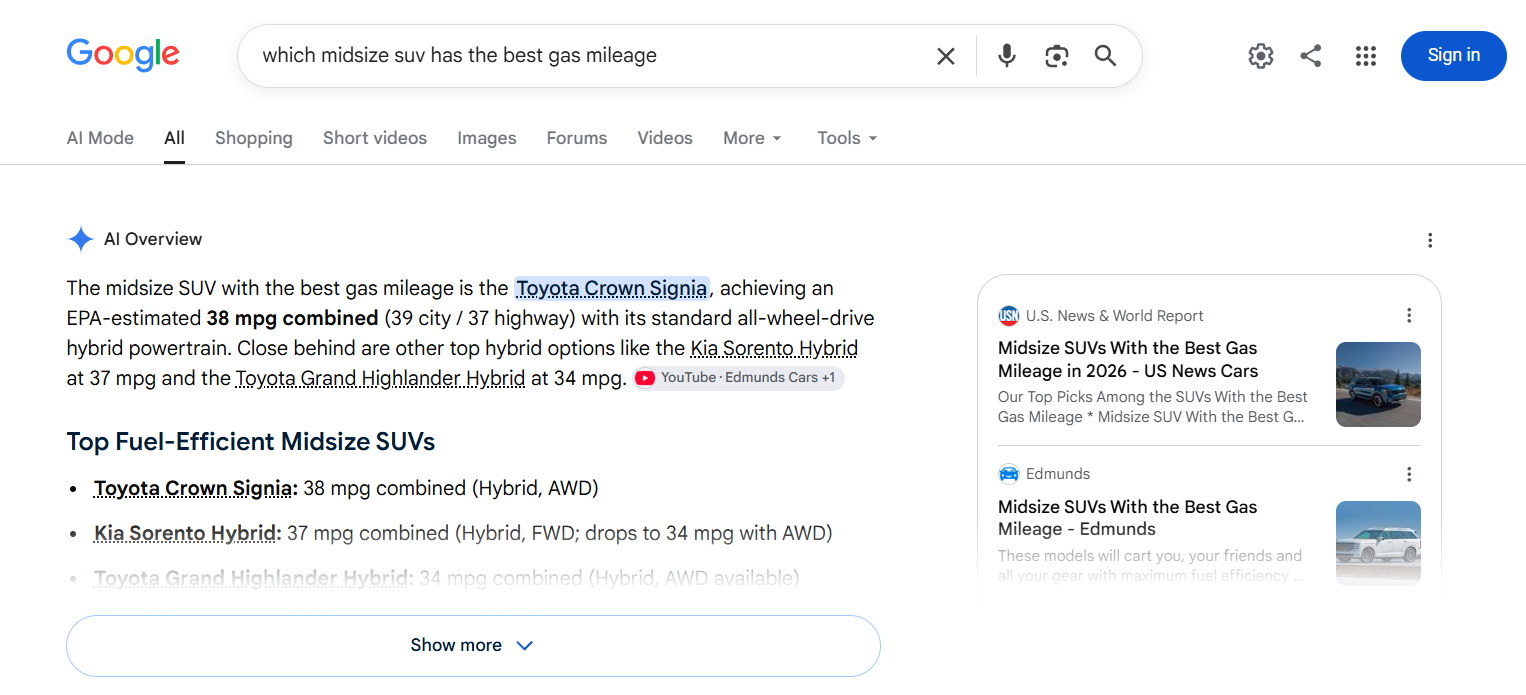
Screenshot example of a Google AI Overview appearing inside an ordinary Google search results page.
What it is: AI Overviews is Google’s AI-generated summary inserted directly into the standard Google Search results page when Google decides an answer would be helpful.
How people access it: By doing a normal Google search on web or mobile. There is no separate app or destination required.
Typical user intent: Quick synthesis, answer-first information gathering, and lightweight research.
Relationship to Search: It is a feature inside Google Search, not a separate search engine.
Why it feels different from classic Google: Instead of immediately scanning the traditional results, the user may see a synthesized answer before or alongside those links, so discovery can happen before any organic click.
What to remember: AI Overviews is a subset of Google Search, not a separate demand pool. It does not represent extra searches. It represents Google searches where the results page itself now contains an AI-generated answer.
How we estimated it
~80B U.S. Google searches per month (Google’s 5-trillion-plus annual disclosure × a 19% U.S.-share proxy, our assumption) × ~80% of searches showing an AI Overview (Search Engine Roundtable, October 2026)
~64B
U.S. searches/month
showing an AI Overview
The ~80B denominator is a floor: the 5-trillion disclosure dates to 2025, and Google says search volume has grown since.
Key sources: Google 5T+ searches, Google I/O 2026, Search Engine Roundtable: over 80% of Google searches have AI Overviews.
Google AI Mode
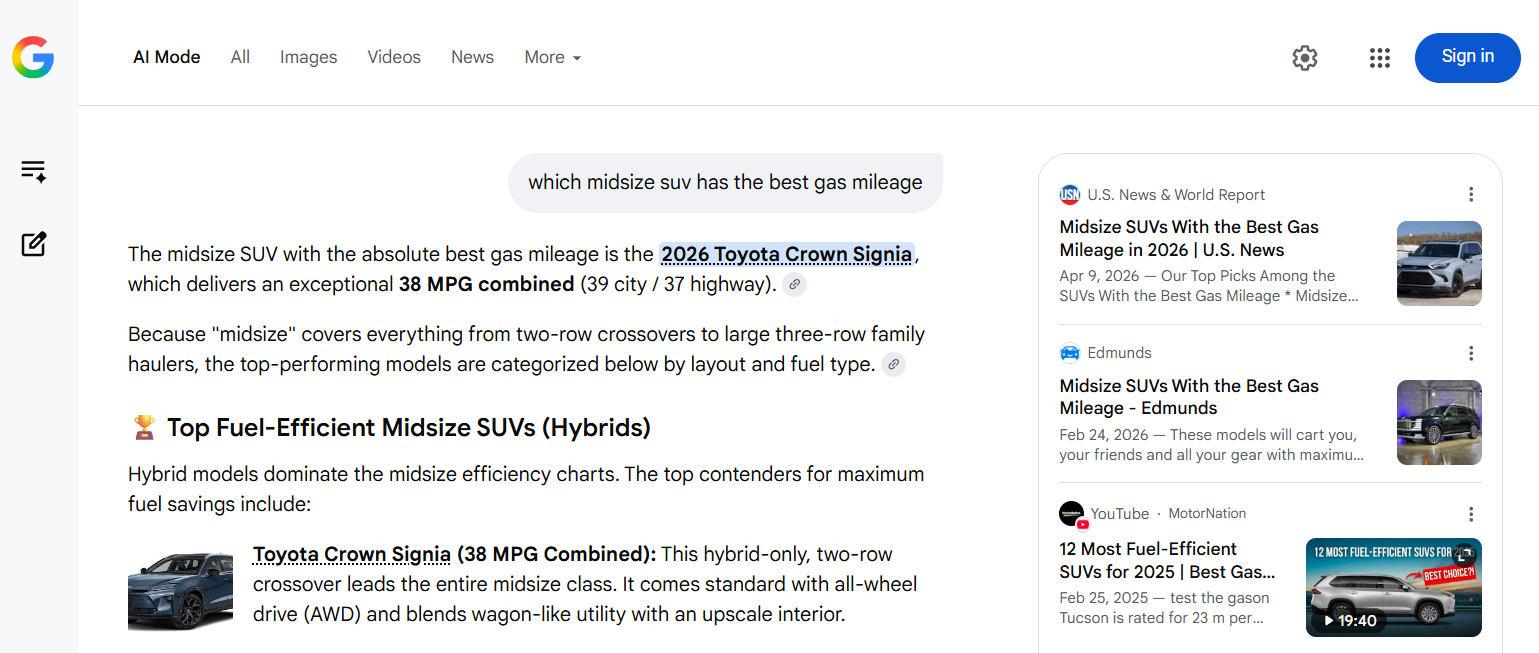
Screenshot example of Google AI Mode answering a shopper’s question in a conversational search experience.
What it is: AI Mode is Google’s dedicated conversational search interface. It is still part of Google Search, but it is designed for deeper exploration, follow-up questions and more complex research journeys.
How people access it: By choosing AI Mode in Search directly, or by continuing from AI-powered search results into deeper follow-up research.
Typical user intent: Comparison, planning, exploratory research and back-and-forth discovery.
Relationship to Search: It is a search-native conversational mode, closer to a research session than a standard results page.
What makes it different from AI Overviews: AI Overviews answers a search inside the existing results page. AI Mode invites the user into a separate, multi-turn research flow – the clearest sign that Google wants Search to become more conversational, not just more summarized.
The average AI Mode query is roughly 3x longer than a traditional search
Typical Google search
best midsize SUV
Typical AI Mode query
What are the best three-row SUVs for a family under $50,000, and which have the best second-row space?
The 3x query-length figure is reported by Google; the example queries are illustrative.
How we estimated it
~280M U.S. AI Mode web visits per month (Similarweb) × a 4x all-surface multiplier for the app and mobile usage Similarweb does not measure (our assumption) × ~2.7 prompts per session (Similarweb)
~3B
U.S. search-like
prompts/month
Less certain than the AI Overviews estimate: Google reports monthly users, not prompt volume, and the 4x multiplier is this estimate’s biggest assumption. Directionally, it points to a very large and rapidly growing research surface.
Key sources: Google I/O 2026, Similarweb 2026 Generative AI Landscape Report.
Google Gemini
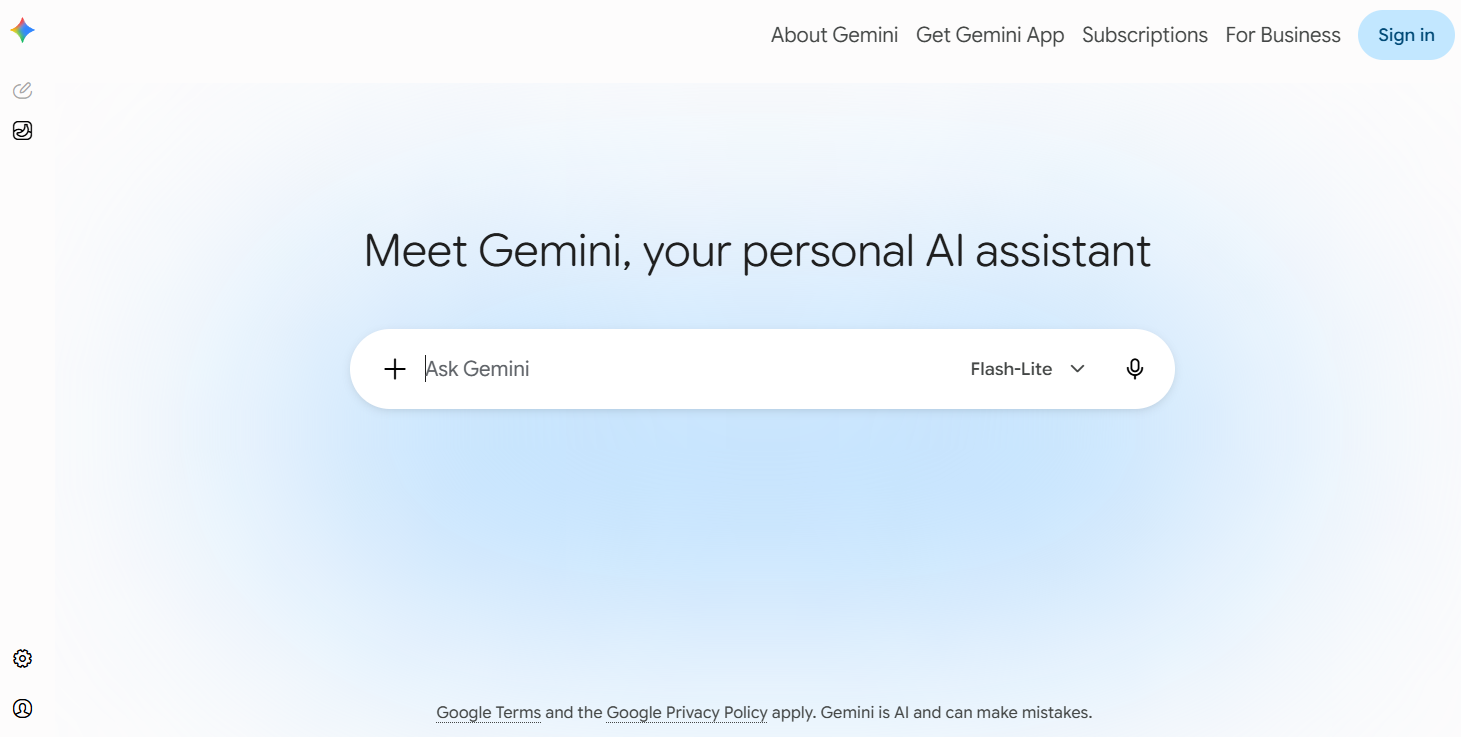
The Gemini web interface. Gemini is a standalone assistant experience rather than just a Search feature.
What it is: Gemini is Google’s standalone AI assistant. It can handle research questions, but it also supports writing, planning, creation, multimodal tasks and assistant-like help across apps and devices.
How people access it: Through the Gemini app, <a href=”http://gemini.google.com” rel=”nofollow”>gemini.google.com</a>, Android and other Google product integrations.
Typical user intent: A mix of research, personal assistance, content creation and general problem solving.
Relationship to Search: Gemini can behave like a search assistant, but it is not limited to search behavior.
Why this gets confusing: AI Mode is explicitly a search experience; Gemini is a broader assistant. And because Google uses Gemini models across several products, people often blur the model, the app and the Search experiences into one thing.
This distinction matters when comparing usage. Google announced that the Gemini app has passed 1 billion monthly users, but that does not tell us how many of those interactions are truly search-like. A person can use Gemini to summarize notes, rewrite copy, generate ideas, or ask factual questions. That is why “Gemini users” cannot be treated as “Gemini searches.”
How we estimated it
~325M U.S. Gemini web visits per month (Similarweb) × a 4x all-surface multiplier for app and mobile usage (our assumption) × ~2.1 prompts per session (Similarweb) × a 52% search-like share (our assumption – Google publishes no Gemini intent split)
~1.4B
U.S. search-like
prompts/month
A directional estimate rather than a platform-reported number: both the all-surface multiplier and the search-like share are assumptions, making this one of the more uncertain figures in the model.
Gemini beyond Google’s own apps
Apple and Google announced a multi-year collaboration in which future Apple Foundation Models will be based on Google’s Gemini models and cloud technology, including models intended to help power a more personalized Siri. That does not mean Siri becomes the Gemini app, but it does suggest Gemini technology will influence an even broader set of user experiences.
Key sources: Gemini 1B monthly users, Google and Apple joint statement, Similarweb 2026 Generative AI Landscape Report.
Side-by-side: the clearest way to remember the differences
Estimated search-like activity
Once the product differences are clear, the scale story becomes easier to understand. Traditional Google Search still appears to be the largest information engine by far. But a growing portion of those searches now produce AI answers, and standalone AI assistants have created a second large pool of search-like behavior.
About these estimates
No platform publishes directly comparable U.S. monthly query totals for these experiences. Where first-party query data is unavailable, we combine measured web activity with clearly stated assumptions for app usage, prompts per session, and search-like intent – each shown in the “How we estimated it” panels above. The AI Mode and Gemini figures carry substantially more uncertainty than the AI Overviews estimate.
Estimated monthly U.S. search-like activity
AI engines and AI answer experiences, with all U.S. Google searches shown in gray for scale
All figures are rough, directional estimates built from public disclosures and third-party data, not platform-reported totals.
The gray bar shows all U.S. Google searches for scale; AI Overviews is the subset of those searches that displays an AI answer. ChatGPT – OpenAI’s general-purpose AI assistant – is shown for comparison; its bar reflects estimated search-like prompts modeled from OpenAI’s disclosed U.S. message volumes. As elsewhere in this article, these are not additive market-share figures because the same person can use multiple engines during the same research journey.
Why this matters in automotive
Automotive is one of the clearest examples of why conversational search matters. Buying or servicing a vehicle involves comparisons, local discovery, specifications, pricing, financing, trade-offs and follow-up questions. That is exactly the kind of research AI handles well.
36%
of in-market shoppers already use AI tools as a vehicle research channel
63%
say they definitely or probably plan to use AI in their next vehicle purchase
25%
of new-vehicle buyers used an AI website or AI-generated search experience while shopping (19% of all vehicle buyers)
Sources: 36% and 63% from Cox Automotive, AI in Auto Retail Tracker; 25% and 19% from the Cox Automotive 2025 Car Buyer Journey Study.
These are answer events, not unique shoppers: one research journey can touch several engines, and an AI Overview appearing on a search that was already happening is not new demand. No platform publishes an automotive share of AI query volume, so we use 1% as a stated working assumption for the share of U.S. search-like AI activity that is broadly automotive-related – triangulated from observed search behavior, Cox Automotive’s current research and category-level AI behavior signals from Similarweb and BrightEdge.
Key takeaways
- Do not lump Google’s AI products together. AI Overviews, AI Mode and Gemini are related, but they represent different user behaviors and should be analyzed separately.
- AI Overviews is the biggest immediate answer layer. Because it rides on top of ordinary Google Search, its scale is already enormous.
- AI Mode is Google’s clearest research product. It is the best signal that Google wants more searches to become conversational and multi-turn.
- Gemini is broader than search. That makes it strategically important, but also harder to compare cleanly with search products.
- Measurement now needs product-level nuance. “AI traffic” is too broad. Any comparison should distinguish which engine, which interface and which kind of behavior is actually being measured.
- Automotive is already feeling the shift. AI is no longer experimental in car shopping. It is becoming part of the real discovery and consideration process.
Frequently asked questions
Are Google AI Overviews, AI Mode and Gemini the same thing?
No. They are related and all use Google’s Gemini model family, but they are different experiences. AI Overviews is an AI answer inside a normal Google search results page. AI Mode is a conversational search mode the user chooses for deeper research. Gemini is a standalone AI assistant that handles many tasks beyond search.
Does AI Overviews add to Google’s search volume?
No. AI Overviews is a subset of Google Search – it appears on searches people were already doing. We estimate roughly 64 billion U.S. searches per month now show an AI Overview, out of roughly 80 billion U.S. Google searches per month.
Can Gemini’s 1 billion monthly users be compared with search numbers?
Not directly. Gemini is a general-purpose assistant, and much of its usage is writing, planning and other non-search work. We estimate about 1.4 billion U.S. Gemini prompts per month are search-like – a directional estimate rather than a platform-reported number.
What does this mean for car dealers?
Vehicle shopping and service research fit conversational AI well, and Cox Automotive found 36% of in-market shoppers already use AI tools as a vehicle research channel. We estimate about 680 million U.S. automotive-related AI answer opportunities per month across Google AI Overviews, AI Mode and Gemini. The practical step is to measure visibility in each experience separately rather than treating AI traffic as one thing.
Key sources
- Google: more than 5 trillion searches annually
- Google I/O 2026: AI Mode 1B users and Search query growth
- Google I/O 2026: AI Overviews 2.5B monthly users
- Google: Gemini app passes 1B monthly users
- Google and Apple joint statement on Gemini-based Apple Foundation Models
- OpenAI: 1B weekly ChatGPT users
- OpenAI: 330M+ daily U.S. ChatGPT messages
- OpenAI / NBER: how consumers use ChatGPT
- Search Engine Roundtable: over 80% of Google searches have AI Overviews
- Similarweb: The 2026 Generative AI Landscape Report
- SparkToro + Datos: Search Happens Everywhere
- Cox Automotive: AI in Auto Retail Tracker
- Cox Automotive: 2025 Car Buyer Journey Study
- Cox Automotive: Fixed Ops & Ownership research
- BrightEdge: automotive branded vs. non-branded AI prompts
- Academic search-behavior study with Personal Vehicles category
How Google AI Overviews, AI Mode and Gemini Differ cargenius.ai/insights/google…
— Michael Novakhov (@mikenov) Nov 25, 2026
#CIA CIA #FBI FBI #Mossad Mossad
How suitable is the Google AI, including the Search and the Gemini, for the Intelligence and counterintelligence collection and analysis? – Google Search – AI OverviewGoogle AI—specifically Gemini and Google Search—is moderately to highly suitable for open-source intelligence (OSINT) and cyber threat intelligence, though it carries severe operational security (OPSEC) and accuracy risks that prevent it from being used out-of-the-box for sensitive counterintelligence. [1, 2, 3]
Its effectiveness depends entirely on whether you use consumer-grade tools or Google’s enterprise security suite.Where It Excels (Collection & Triage)
Automated OSINT and Deep Research. Google’s ecosystem combines live web indexing with multi-step reasoning. Features like Gemini Deep Research can execute fan-out queries, synthesize disparate public web sources, and generate rapid baseline reports on geopolitical events, entities, or public networks. [1, 2]
Cyber Threat Intelligence (CTI). In enterprise environments, Google Threat Intelligence integrates Gemini with Mandiant and VirusTotal datasets. Analysts can query threat actor TTPs (Tactics, Techniques, and Procedures) in plain language, summarize dense incident reports, and use AI-powered code insights to deobfuscate and analyze suspected malware. [1, 2, 3]
Log Analysis and Detection. Within Google Security Operations, Gemini translates natural language into complex search queries across massive telemetry logs and assists in writing detection rules to spot anomalous insider or adversary behavior. [1]Critical Limitations & Counterintelligence Risks
Severe OPSEC and Data Exposure. Consumer versions of Gemini and Google Search AI Mode log queries, retain interaction data, and can use inputs to train models unless explicitly disabled. Inputting classified, proprietary, or sensitive counterintelligence indicators into public interfaces creates a major data-leakage risk. Enterprise deployments require strict tenant isolation (such as Google Cloud’s sovereign or air-gapped environments).
Hallucinations and Source Opacity. Users on Quora agree that Gemini can generate fluent but factually incorrect claims. Furthermore, Gemini does not always provide public website citations for every claim, making strict tradecraft verification and primary-source validation mandatory before acting on any output.
Prompt Injection and Data Poisoning. In counterintelligence collection, adversaries actively manipulate public data. If Gemini ingests poisoned web pages or maliciously crafted documents during collection, it is vulnerable to indirect prompt injection or being steered toward false analytical conclusions.
Rigid Output Formats. Opinions are mixed among users on Reddit regarding Gemini’s Deep Research tool; while some praise its analytical insights, many note that it stubbornly defaults to essay-style summaries rather than following strict, structured intelligence formatting. [1, 2, 3, 4, 5, 6]Deployment Comparison
CapabilityConsumer Google Search / GeminiEnterprise Google Cloud / Threat IntelBest Use CaseRapid, non-sensitive OSINT & backgroundingMalware triage, log hunting, & private data synthesisData Privacy / OPSECLow (queries logged/used for ads or training by default)High (governed by enterprise compliance & data boundaries)Adversary DataPublic web index onlyPublic web + Mandiant, VirusTotal, & internal telemetryPrimary RiskOperational compromise via search history & hallucinationsOver-reliance on automated triage without human review
Recommended Approach
If you are conducting unclassified OSINT, use Google Search AI and Gemini to accelerate initial discovery and map public narratives, but strip out all identifying operational context from your prompts. For active counterintelligence or sensitive investigations, restrict usage strictly to isolated enterprise instances (such as Vertex AI or Google Threat Intelligence) where zero data retention is contractually enforced, and treat all AI outputs strictly as unverified leads.— Michael Novakhov (@mikenov) Nov 25, 2026