Categories
Michael Novakhov - SharedNewsLinks℠

Bombshell Drops in FBI’s Stephen Miller Phone Call Meltdown


Michael_Novakhov
shared this story
.

Prosecutors are expected to charge a man soon for allegedly threatening Katie Miller, the wife of top White House official Stephen Miller, despite FBI fears that no federal crime was committed, according to a report.

Justice Department prosecutors in Boston are being encouraged to bring charges even though there are internal concerns about the strength of the evidence, Bloomberg reported Monday.

The news comes after the resignation of FBI Deputy Director Andrew Bailey, who reportedly disagreed with how the bureau demoted two counterterrorism agents who pushed back on the probe into Miller’s caller.

The Justice Department is preparing to file an indictment or a criminal complaint potentially this week, people familiar with the matter told the publication. The specific charge hasn’t been decided upon. Yet prosecutors in the Massachusetts U.S. Attorney’s office, like some in the FBI, are wary about whether they have enough proof to secure a conviction, they added.

Former Justice Department officials familiar with the case told Bloomberg that the criteria for a federal threats case don’t appear to have been met. Instead, they said, the case was more of a matter for local police.

MAGA podcaster Katie Miller doesn't think

MAGA podcaster Katie Miller doesn’t think

The Justice Department did not immediately respond to a request for comment from the Daily Beast, nor did the FBI. A spokesperson for the U.S. Attorney’s office in Boston declined to comment to Bloomberg.

Last Friday, Michael Burgwald, the FBI’s Washington Field Office counterterrorism chief, and his deputy, Courtland Rae, were removed from their positions and transferred to FBI headquarters.

The decision came amid the Millers’ frustration that investigators were moving too slowly, Bloomberg Law reported.

“Senior leadership at the FBI determined they were stifling investigations into very serious threats and made a unilateral decision to remove them,” White House spokeswoman Lauren Bis told the outlet last week.

Miller is an architect of the Trump administration's immigration policy. / Evelyn Hockstein / REUTERS

Miller is an architect of the Trump administration’s immigration policy. / Evelyn Hockstein / REUTERS

Burgwald and Rae led the FBI Washington field office’s counterterrorism division. They reportedly questioned the directive to look into Miller’s allegations.

“Harassing phone calls aren’t even in the ballpark of terrorism unless an actual terrorist is doing the dialing,” as one ex-FBI official briefed on the matter told MS NOW.

The FBI said the two agents were demoted by Washington bureau chief Darren Cox, not FBI Director Kash Patel, though MS NOW reported Patel was displeased with them regarding the Miller matter.

More to explore

“This was a personnel decision made at the Washington field office level alone based on our constant evaluation of mission needs. Any suggestion otherwise is false,” Cox said. “Director Patel did not order this decision.”

Katie Miller, 34, was an assistant press secretary in the Department of Homeland Security in the first Trump administration. She later joined then-Vice President Mike Pence’s communications staff. For the first half of 2025, she was the communications director for the so-called Department of Government Efficiency.

Miller is now a podcast host, and occasionally appears on Fox News. In May, she said on that network that a viral post by the Democrats’ official X account telling her husband to “shut up” was “violent.”

Categories
Michael Novakhov - SharedNewsLinks℠

Dutch ‘reformed hacker’ arrested in ShinyHunters investigation, police and ex-boss say


Michael_Novakhov
shared this story
.

Man types on a computer keyboard in front of the displayed cyber code in this illustration picture

A man types on a computer keyboard in front of the displayed cyber code in this illustration picture taken on March 1, 2017. REUTERS/Kacper Pempel/Illustration Purchase Licensing Rights, opens new tab

  • Summary
  • Dutch police say suspect, 24, to appear in Rotterdam court
  • Former boss identifies suspect as ex-hacker Pepijn van der Stap
  • Memo says FBI presumes hackers have stolen data on all employees

AMSTERDAM, Sept 28 (Reuters) – A Dutch man ​whose journey from cybercriminal to reformed security professional was widely covered in the international media has been arrested as part ‌of an investigation into the hacker group ShinyHunters, Dutch police and the man’s boss said on Monday.

In a statement, opens new tab

posted to social media site X, Dutch police said a 24-year-old man had been arrested in connection with the inquiry and would appear in court in Rotterdam on Tuesday.

The Misinformation Monitor newsletter rounds up international misinformation narratives, with a “Real or Fake?” quiz in every edition. Sign up here.

The statement did not name the man. But ​Benjamin Korper of Amsterdam-based cybersecurity company Neo Security said it was Pepijn van der Stap, the company’s offensive security lead.

In a ​telephone interview with Reuters, Korper said Dutch forensic investigators visited his office on September 15, the night Van der ⁠Stap was arrested in a dramatic police raid that

involved flash bang grenades, opens new tab

.

The arrest comes amid escalating concern over ShinyHunters, a hacking group known ​for large-scale data breaches and extortion, and its recent theft of what it said was terabytes of sensitive personnel data from US FBI servers. ​At least some of the data includes employees’ intelligence assignments and medical records, Reuters has reported. Some compared this to the disastrous 2015 hack of the US Office of Personnel Management.

An internal memo circulated to staffers said the FBI was operating under the presumption that hackers stole data pertaining to all bureau employees, according to a person briefed on ​the matter. In a statement, the FBI said it was “working around the clock” to investigate the hack and was “in regular communication with anyone ​who may be impacted.” The memo’s existence was earlier reported by MS Now.

In a statement, ShinyHunters said Van der Stap had “no association” with the group and that ‌Dutch police ⁠were incompetent. The hackers said that now they were not setting a deadline for the FBI to rescind

an advisory about ShinyHunters, opens new tab

, softening their initial statement which gave the FBI a week.

“This was not a threat,” they said. “Nothing will happen.”

News of Van der Stap’s arrest,

first reported, opens new tab

by independent journalist Brian Krebs, caused a stir in the cybersecurity community.

Van der Stap’s 2023 convictions of data theft and extortion had already received widespread publicity, as did ​his subsequent public disavowal of cybercrime. ​On his personal website, Van ⁠der Stap acknowledged that his journey “hasn’t been a straight line” but said his experience had taught him that “knowledge is for building and protecting, not breaking.”

Korper said he had carefully vetted Van der Stap before hiring him, ​monitored him during his employment, and was shocked by the arrest.

“I truly believe that people deserve a ​second chance, but in ⁠this case I was not thanked for it,” Korper said. “Absolutely everybody I talked to is flabbergasted.”

The executive said he had hired an outside firm to investigate whether Van der Stap had hacked Neo Security or its customers, but so far investigators have found no evidence that he acted against his ⁠employer or ​its clients.

Korper and Van der Stap have not been in touch since the arrest, Korper ​said. Attempts by Reuters to reach Van der Stap or identify a lawyer or representative were not successful.

Adds comment from FBI in paragraph 6

Reporting by Anthony Deutsch in Amsterdam, and Raphael Satter and Andrew Goudsward ​in Washington; Additional reporting by AJ Vicens in Detroit. Writing by Makini Brice and Raphael Satter; Editing by Andrew Heavens, David Gaffen and David Gregorio

Our Standards: The Thomson Reuters Trust Principles., opens new tab

Categories
Michael Novakhov - SharedNewsLinks℠

Top Trump FBI Chief Quits After Katie Miller Meltdown


Michael_Novakhov
shared this story
from The Daily Beast Latest Articles.

ANOTHER ONE BITES THE DUST

The departure is the latest shakeup during the tumultuous tenure of FBI director Kash Patel.

Andrew Bailey, Katie Miller photo illustrationi

Photo Illustration by Eric Faison/The Daily Beast/Getty

Donald Trump has lost another senior official, with the FBI’s deputy director leaving days after two veteran counterterrorism chiefs were abruptly reassigned over their handling of an investigation involving Stephen Miller’s wife.

FBI Deputy Director Andrew Bailey announced on Monday that he was stepping down to return to his family in Missouri, just one year after taking on the job as the bureau’s second highest ranking official following the departure of MAGA podcaster Dan Bongino.

Categories
Michael Novakhov - SharedNewsLinks℠

Embarrassing Breach at F.B.I. Fuels Fears of Harm to Its Employees


Michael_Novakhov
shared this story
.

Advertisement

SKIP ADVERTISEMENT

In an internal memo, the F.B.I. said it believed the hackers may have stolen sensitive information on all of its employees.

A criminal hacking group known as ShinyHunters said it had targeted the F.B.I. as retribution for its public warning in the spring that the group was known to harass its victims and their family members.Credit…Tierney L. Cross/The New York Times

The theft by a criminal hacking group of reams of sensitive personal data involving potentially tens of thousands of former and current F.B.I. employees is emerging as one of the worst breaches of sensitive government information, leaving the bureau rushing to protect its personnel as an uncertain deadline loomed.

Nearly a week after the group, known as ShinyHunters, revealed it had pilfered intimate details about bureau personnel from the agency’s jobs portal and threatened to leak them online, F.B.I. investigators are still piecing together how the breach took place and the total damage.

The hack appears to have swept up home addresses, Social Security numbers, secretive job assignments and much more, according to a New York Times analysis of some of the records. Some are already comparing it to China’s breach of more than 20 million records from the Office of Personnel Management over a decade ago, considered so catastrophic that officials and lawmakers vowed to never let something like it happen again.

Many F.B.I. employees first learned about the hack when news reports about it surfaced on Tuesday, according to current and former officials. The next day, F.B.I. staff received an email reminding them that October is cybersecurity awareness month, which struck some as tone deaf in light of the breach, one of those people said.

On Friday, bureau leaders, in an internal memo to its rank and file, declared the hack a cybersecurity incident and acknowledged its employees had personal information stolen.

“We are operating under the premise that the threat actor is also exfiltrating PII of all F.B.I. employees,” according to the memo, which was described by someone who had seen it, using the abbreviation for personally identifiable information.

The memo said the agency would offer virtual briefings in the weeks ahead and instructed employees to remain vigilant at home and at work, report any unsolicited contacts or threats, avoid answering calls from unknown numbers and set up voice mail accounts with A.I.-generated voices. “Bureau leadership remains committed to supporting the safety of you and your family,” it said.

Still, many past and present personnel remain in the dark about whether their data has been purloined. In recent days, some have anxiously asked Times reporters whether their names are contained in the hacked data, wondering whether they needed to take steps to protect themselves or their families.

In a statement on Monday, the agency said it was “working around the clock to investigate the cyber incident involving FBIJobs.gov and is in regular communication with anyone who may be impacted — including multiple bureau-wide communications within 24 hours of public reporting.”

It added, “The F.B.I. treats the security of its information and the safety of its work force as top priorities, and our investigation is ongoing.”

In announcing its hack, ShinyHunters, believed to be a loose collective of young hackers operating across the globe, said it had targeted the F.B.I. as retribution for a public advisory the bureau had issued in the spring, warning that the group was known to harass victims and family members with threatening or coercive maneuvers. In their note, the hackers demanded that the F.B.I. “correct or simply REMOVE” the advisory or risk further consequences.

In an email to The Times on Friday, ShinyHunters said that the bureau had until the end of Tuesday to fulfill its request, even as the hackers themselves appeared to acknowledge that the bureau was unlikely to acquiesce.

That note left open the possibility that the hackers would not dump the data online, even as the group reiterated its deadline. But on Monday, in a new statement, the group claimed it never intended to do so.

“Since the very beginning we had made our decision that we would never publish this data,” the group said. “We have never intended to nor have we ever planned to.” It added that the hack and threat to the F.B.I. was a “marketing campaign to protect our business” and said that “we are not taking any further actions” with the data, including revealing more about what is contained in the files.

“We seek no escalation as our goals have widely been accomplished,” it said.

It remains to be seen what ShinyHunters will do, and security researchers warned that even if they did not publish it online they could still sell it to other criminals or foreign governments.

It is also unclear just how much sensitive information the hackers stole. The group claimed publicly to have stolen records on everyone who has applied for a job at the F.B.I., and told The Times that the people with compromised information numbered in the tens of thousands.

Ciaran Martin, the former head of Britain’s cyberdefense agency, said the F.B.I. hack likely had “huge impact on the operational capability” of the bureau and could rank as one of the most consequential data breaches in history — graver even than the Office of Personnel Management burglary.

“Losing the data on 20 million federal employees to the Chinese was bad,” Mr. Martin said. “But you knew the Chinese weren’t going to sell or publish it.”

Image

T.S.A. PreCheck numbers that are provided to F.B.I. employees were among the private personal data obtained by the hackers.Credit…Jamie Kelter Davis for The New York Times

A sample of records that the hackers have shared with The Times and other news organizations includes newer hires as well as retired ones, with birth dates ranging from the early 1940s to the mid 2000s. The most recent date references in the spreadsheet were from late April, suggesting the stolen files are at most only months old.

Current and former U.S. officials said that at least portions of the sample, and potentially all of it, appeared to be authentic.

Sign up for the On Politics newsletter.  It’s a pivotal moment for American politics. Join us for 2026 and beyond.

A Times review of the sample found that it contained a range of private personal data, including:

  • The names, home addresses, phone numbers, work emails, Social Security numbers and birth dates and hire dates of current and former F.B.I. personnel.

  • Names and numbers for spouses and other emergency contacts, including in some cases parents, siblings and even children.

  • Employee identification numbers that are used for the Transportation Security Administration’s PreCheck program, which could aid spies in tracking travel itineraries of agents, including those that work undercover.

  • Names of the units in which F.B.I. personnel are employed and their job titles, as well as the names of supervisors. While some list mundane departments, others reveal extraordinarily sensitive assignments including counterintelligence, narcotics and various desks focused on Russian, Chinese and Iranian national security threats. F.B.I. agents in those roles are generally expected to zealously protect their work in such fields to avoid putting a target on their back.

Additionally, ShinyHunters said that it had stolen medical data about employees, including psychiatric records and documents related to blood and urine tests. It also said that it had additional background check files on employees.

Former bureau officials and security experts said the hacked data prompted no end of worries. The data could also make it far easier for violent criminals to seek revenge against F.B.I. agents who sent them to prison. When they submit paperwork against criminal suspects, F.B.I. agents sign their names to the records but are typically trained to not let delicate personal information easily emerge online.

“It doesn’t take much imagination to picture scenarios where employees or their families could be threatened or harmed by this kind of information being released,” said Andrew Brandt, a threat intelligence researcher at the cybersecurity company Huntress. “The bigger worry is ShinyHunters selling the data to other criminal or nation-state groups who could put it to more damaging use, rather than dumping it themselves.”

Security experts said that given the breadth of the records, they would be of enormous value if they were acquired by foreign spies, who could then use the material to build elaborate dossiers on F.B.I. agents — including those who may be undercover or later assigned to such a post — and track them for years, if not decades. Aided by artificial intelligence, spies or hackers could also combine the information with other exposed data that is already in their hands or that is easily acquired on the dark web.

“Breaches do not exist in a vacuum,” Justin Sherman, a senior associate at the Center for Strategic & International Studies, wrote in a recent essay arguing that different exposed data sets can be combined and analyzed by hostile spy services.

The hack is just the latest in a string of embarrassing security failures for the F.B.I.

Two years ago, government investigators learned that Chinese spies had compromised vast segments of the nation’s telecommunications infrastructure in a hacking campaign known as Salt Typhoon. Among the most startling revelations was that the breach included sensitive wiretap networks at Verizon and AT&T that process court-authorized surveillance orders for the F.B.I. to monitor domestic criminal suspects.

China has denied involvement, but U.S. intelligence officials considered the compromise a counterintelligence failure of the highest magnitude, with national security implications that could last for years. It prompted such alarm within the F.B.I. that field offices were told to check if informants had been potentially compromised and, if necessary, take steps to ensure their safety.

The bureau still does not understand the full scale or scope of Salt Typhoon and its exposure from it, according to current and former U.S. officials. But the F.B.I. received another blow this spring when suspected Chinese hackers were found again inside a network it maintains for domestic surveillance orders.

In the case of ShinyHunters, it was not Chinese spies but a notorious gang of cybercriminals who hit the F.B.I. Already, bureau leadership had warned staff that hackers linked to ShinyHunters who infiltrated AT&T in 2024 may have stolen months of call and text logs belonging to some of its agents, which also fanned concerns about whether its informants had been exposed, as Bloomberg reported last year.

The members of ShinyHunters are seen as highly skilled — and audacious — English-speaking hackers who extort their victims for millions of dollars and brag about their exploits. In their recent correspondence with The Times, the hackers have favored British spellings of certain words.

A French citizen charged with participating in some ShinyHunters attacks was arrested in Morocco in 2022, extradited to the United States and sentenced to three years in prison. Other suspected members were arrested last year in France.

On Monday, a security journalist, Brian Krebs, reported that authorities in the Netherlands had arrested a 23-year-old convicted cybercriminal on suspicion of aiding in data thefts and extortions tied to ShinyHunters just days before the F.B.I. breach. ShinyHunters said in response on Monday that the Dutch suspect “has no association with us.”

The F.B.I.’s Dallas field office has been leading an investigation into ShinyHunters and working with international partners to hunt down other members, according to people familiar with the matter who were not authorized to speak publicly.

It is not clear exactly how ShinyHunters pulled off the F.B.I. hack. The group said it had used a zero-day, or previously undiscovered, coding flaw within the Oracle PeopleSoft software, an application that companies use for human resources and financial management.

But some security researchers said the story may be more complicated. On Friday, Google revealed in a blog post that its threat intelligence teams have recently seen ShinyHunters renewing a campaign of “mass exploitation” against victims using a bug with Oracle PeopleSoft that was publicly disclosed with a patch in June. The post does not mention the F.B.I. breach, but a person familiar with the matter said investigators believe the known bug was involved in the ShinyHunters theft of personnel files.

The flaw was considered important enough that the Cybersecurity and Infrastructure Security Agency promptly added it to a catalog of high-risk known vulnerabilities that federal agencies are instructed to quickly address.

“This type of vulnerability is a frequent attack vector for malicious cyber actors and poses significant risks to the federal enterprise,” CISA said at the time.

In response to questions from The Times, ShinyHunters said in an email on Friday that the F.B.I. had not contacted the group and that it would hold firm to its Tuesday deadline.

The hackers said that the severity of the breach was “SIGNIFICANTLY” worse than publicly known but did not explain in what way. Cybersecurity researchers who have followed the collective have said it has a track record of sometimes embellishing its activities but so far, in this breach, its claims have been largely corroborated.

“We have no intention to reveal the true impact, we will leave that to the F.B.I.,” ShinyHunters said. “If they lie, we will not correct them.”

The group also said that it was aggrieved by the F.B.I.’s advisory and that the hack was “all about protecting our business.”

“This is happening so we are heard and acknowledged,” ShinyHunters said. “We may sound like children whose feelings are hurt, sure, but in our game, reputation is all that matters.”

Dustin Volz writes about cybersecurity and intelligence for The Times. He is based in Washington.

Alan Feuer is a reporter for The Times who covers the effects President Trump has had on the courts, the Justice Department and the broader rule of law.

Charlie Savage writes about national security and legal policy for The Times.

Adam Goldman is a London-based reporter for The Times who writes about global security.

Related Content

Advertisement

SKIP ADVERTISEMENT

Categories
Michael Novakhov - SharedNewsLinks℠

Andrew Bailey, No. 2 at FBI, resigns in latest shake-up at bureau


Michael_Novakhov
shared this story
.

The conservative firebrand whom the Trump administration installed as a No. 2 at the FBI announced Monday that he is resigning from the bureau.

Andrew Bailey, the former Missouri attorney general who has supported debunked claims that the 2020 election was stolen, told bureau employees in an email that he was leaving to spend more time with this family, according to three people familiar with the personnel move who spoke on the condition of anonymity to discuss a matter they were not authorized to speak about.

Bailey, who was hired into the leadership role about a year ago, confirmed his departure in a social media post.

“With great pride in what we have accomplished, I am announcing that I am stepping down to return to my family in Missouri,” Bailey wrote on social media. “I am confident Director Patel will continue to reform the FBI, combat violent crime, defend the homeland, ensure strong organizational accountability, and restore public trust in this institution of excellence.”

The departure marks a dramatic turn for Bailey, a loyalist of President Donald Trump who had been floated as a candidate early in the administration to run the FBI or Justice Department.

It is also the latest shake-up at the federal law enforcement agency under FBI Director Kash Patel. Bailey was hired to serve as the co-deputy director alongside Dan Bongino, a conservative podcast host and former Secret Service officer.

Neither Bongino nor Bailey had FBI experience, which made them highly unusual picks for a position that typically goes to a veteran of the bureau. The position does not require Senate confirmation and is tasked with running the day-to-day operations of the FBI.

Earlier this year, Bongino quit amid frustrations about the demands of the position, The Washington Post previously reported. He was replaced with Christopher Raia, a career FBI official.

During Bailey’s tenure, the department has seen an unprecedented wave of dismissals and transfers of experienced FBI agents.

Last week, for example, the top two agents running the counterterrorism division in the Washington field office were transferred because of their work investigating threats against Katie Miller — a conservative podcaster who is the wife of top Trump aide Stephen Miller — according to three people familiar with the matter.

The officials were transferred because top officials felt work on the probe was moving too slowly, said the people, who spoke on the condition of anonymity to discuss a personnel matter.

Bailey resigned from his position as Missouri attorney general last September to assume the role as FBI co-deputy director.

He is a military veteran who as Missouri’s chief legal officer mounted high-profile legal fights aligned with Trump’s agenda. He sued Starbucks over its diversity, equity and inclusion policies; fought transgender care policies; and waged legal battles against “sanctuary city” policies.

Among the most notable parts of Bailey’s short FBI tenure was his presence on the scene as the FBI executed search warrants in January to seize 2020 ballots and other election material from Fulton County, Georgia.

It is rare for an FBI deputy director to personally oversee such a routine development in an investigation, but Bailey’s presence was also notable given the political tensions surrounding the probe and Trump’s repeated insistence, without evidence, that the 2020 election was stolen. The FBI has said it is investigating whether what it has described in court filings as “deficiencies” in the 2020 vote tabulation in Fulton County, home to Atlanta, were the result of intentional wrongdoing that could constitute a crime.

Categories
Michael Novakhov - SharedNewsLinks℠

“Very serious threats”: FBI officials demoted after Katie Miller theats probe


Michael_Novakhov
shared this story
.

Two veteran FBI counterterrorism officials were demoted after investigators determined allegedly harassing calls to a top White House aide’s wife did not warrant further investigation, according to multiple reports.

Michael Burgwald, who led counterterrorism operations at the FBI’s Washington Field Office, and his deputy, Courtland Rae, were removed from their leadership positions Friday and reassigned to FBI headquarters.

The shakeup followed an investigation into allegedly threatening and harassing calls received by Katie Miller, a conservative podcaster married to White House Deputy Chief of Staff Stephen Miller.

A field office team reviewed the calls but found they did not meet the threshold for an FBI investigation and identified no connection to terrorism, CNN reported, citing people familiar with the matter.

That conclusion reportedly caused friction with FBI leadership.

Bloomberg Law, which first reported the demotions, said Washington Field Office leadership was dissatisfied with the pace of the investigation and that the Miller family shared those frustrations. FBI Director Kash Patel was also displeased with the office’s progress, according to the outlet.

The FBI and White House have pushed back on suggestions that the Millers or Patel ordered the personnel changes.

Washington Field Office chief Darren Cox said he made the decision himself.

“Director Patel did not order this decision,” Cox said. “This was a personnel decision made at the Washington field office level alone based on our constant evaluation of mission needs.”

White House spokesperson Lauren Bis said the Millers had never met or interacted with Burgwald or Rae.

“Senior leadership at the FBI determined they were stifling investigations into very serious threats and made a unilateral decision to remove them,” Bis said.

Details about the calls themselves have not been made public, leaving unclear what investigators reviewed or why they concluded the messages did not warrant further FBI action.

Start your day with essential news from Salon.
Sign up for our free morning newsletter, Crash Course.

The reassignments also remove decades of counterterrorism experience from the Washington office as the United States remains at war with Iran.

Burgwald is a West Point graduate who has received multiple attorney general’s awards. Rae helped oversee the FBI’s response to the 2013 Boston Marathon bombing. Both officials also worked on investigations related to the Jan. 6, 2021, attack on the Capitol.

The Millers and their children moved from their Virginia home into military housing last year amid what the White House has described as a campaign of stalking, doxing and threats against the family.

The post “Very serious threats”: FBI officials demoted after Katie Miller theats probe appeared first on Salon.com.

Categories
Michael Novakhov - SharedNewsLinks℠

ShinyHunters hackers say they stole psychiatric and medical records of FBI staff


Michael_Novakhov
shared this story
.

  • Summary
  • Hackers claim stolen data includes health information
  • Reuters has partially authenticated some of the files
  • FBI says it is ‘aggressively’ investigating reported breach
  • ShinyHunters is a notorious hacking crew

WASHINGTON, Sept 25 (Reuters) – FBI personnel data recently stolen by the ShinyHunters hackers includes sensitive psychiatric and medical ​evaluation records, according to the hackers and documents reviewed by Reuters.

ShinyHunters, one of the world’s most notorious and attention-seeking hacking crews, first said ‌it had breached the FBI on Tuesday. In the hack, the group obtained granular details about bureau employees and their assignments, Reuters previously reported, including sensitive work against Chinese spies, Russian intelligence, drug cartels and others.

The Misinformation Monitor newsletter rounds up international misinformation narratives, with a “Real or Fake?” quiz in every edition. Sign up here.

The breach has already rattled the bureau, but now threatens to turn into a serious counterintelligence risk, said Eric O’Neill, a former FBI operative who founded the cybersecurity consultancy Nexasure AI.

O’Neill said the presence of ​medical data was a sign that the hack was approaching the same kind of magnitude as the 2015 intrusion into the Office of Personnel Management, which ​exposed millions of Americans’ sensitive clearance information, allegedly to Chinese intelligence.

He added that the data would be a powerful magnet for ⁠hostile spies.

“I would be shocked if Russian intelligence isn’t knocking on their door and saying, ‘We want that stuff, hand it over,'” said O’Neill.

The FBI declined to comment on the ​records. In a statement issued Wednesday, the bureau said it was “aggressively investigating” the reported breach.

ShinyHunters circulated the medical files to a small circle of reporters earlier this week after announcing ​it had broken into the FBIjobs.gov site and stolen what it claimed was 2 to 3 terabytes of data.

The BBC earlier on Friday reported that

a blood and urine test document, opens new tab

was among the sample, but the presence of other sensitive files, including a mental health evaluation and other records, has not previously been reported.

Reuters was able to partially authenticate some of the half-dozen files in several ways, ​including running two social security numbers in them against credit bureau data, and lining up the date of a pre-employment mental health evaluation against a former FBI analyst’s ​LinkedIn profile. Reuters also matched the name of an FBI psychiatrist in the document to a LinkedIn profile with the same name and an identical job title.

In one case, Reuters was able ‌to confirm with ⁠a person familiar with the matter that a medical professional listed in one of the documents as performing FBI evaluations was in fact doing so at the time, although the person could not authenticate the entire file.

The person spoke on condition of anonymity because they weren’t authorized to discuss the matter.

The psychiatrist and the FBI employees named in the data either did not return messages or declined comment.

DOCUMENTS INCLUDE MEDICAL SPECIFICS

The documents reviewed by Reuters range in sensitivity. One medical record, which was part of a “fitness for duty” ​exam given to prospective employees, noted that ​an applicant took aspirin daily and was ⁠allergic to dust and cats.

Another record said a potential employee exhibited “symptoms of depression” in high school. A third document carried an electrocardiogram result.

Reuters could not establish whether the limited number of documents viewed were representative of the rest of the data trove held ​by ShinyHunters, or whether there even were other documents.

An FBI advisory released in May said the group has in the past ​exaggerated its level of ⁠access in an attempt to extort its victims.

ShinyHunters told Reuters on Tuesday the data it had was “very very very sensitive” and included medical information, discharges, prescriptions, clinical visits, and “any health issues with Agents.”

The hackers said they had compromised several of the bureau’s internal services, including the FBI’s background and employee applicant screening system, FBI MedLink, which contains agency personnel medical records, and ⁠the FBI’s ​Background Investigation Contract Services unit. Reuters could not corroborate those specific allegations.

Initially, the group said it would ​hold the data hostage until the FBI retracted its May advisory, which it said it took exception to. Since then ShinyHunters has removed that defiant statement from its website, saying Thursday it would not comment on ​what it would do “if the victim does not comply with our kind request.”

Story updated with context and additional detail in paragraphs 10 through 15

Reporting by Raphael Satter in Washington and AJ Vicens in Detroit; editing by Chris Sanders and David Gaffen

Our Standards: The Thomson Reuters Trust Principles., opens new tab

Categories
Michael Novakhov - SharedNewsLinks℠

Foiled terror plot at bomber base signals wider threat to US military installations: expert


Michael_Novakhov
shared this story
from Latest & Breaking News | Fox News.

Five men arrested near a key U.S. bomber base in the U.K. on Sunday may have planned a “complex,” coordinated attack with potentially far-reaching security implications for American military installations globally, a former U.S. intelligence official warned.

As counterterrorism police investigated after officers detained the suspects near RAF Fairford in Gloucestershire, a former Pentagon official also said President Donald Trump will ultimately be the one to decide the consequences if indeed the “trail leads to Tehran.”

The men were initially held on suspicion of offenses under Britain’s Explosives Act before being arrested on terrorism charges in connection with the airfield, a key U.S. Air Force hub and the primary European base for American strategic bombers.

On Sunday, Trump said U.S. authorities had been monitoring the suspects prior to their capture.

FORMER UK PRIME MINISTER TONY BLAIR WARNS EUROPE ‘WE DON’T WIN’ IN WAR WITHOUT US SUPPORT

Police at a road block on the road to RAF Fairford after a major incident was declared, with armed police manning a cordon near the village of Whelford in Gloucestershire, near RAF Fairford on Sunday, September 27, 2026. (Ben Birchall/PA Images via Getty Images)

“We had them under investigation,” Trump told reporters in Chicago. “They were looking to do big damage to our fort.”

“It may have been Scotland Yard. I don’t know. We worked with a lot of them. We had them under view for a long time, and we got them,” Trump added.

According to Sky News, counterterrorism police were investigating whether Iran is linked to the suspected bomb plot.

Former Trump White House official Morgan Murphy told Fox News Digital that British authorities are leading the investigation alongside U.S. law enforcement and intelligence.

“Every phone, bank record and rental receipt will be run through British and American intelligence, and if the trail leads to Tehran, it will be found,” Murphy clarified.

“But as American airmen and bombers seem to have been the target, Air Force investigators on the base, the FBI in London, and American intelligence will likely all work the case.”

“If conclusive evidence proves Iran is behind an attempted attack on U.S. forces, the American President will ultimately decide how Tehran pays,” Murphy added.

BRITAIN INTRODUCES SWEEPING NEW POWERS TO TARGET FOREIGN STATE-LINKED GROUPS INCLUDING IRAN’S IRGC

A US Air Force Boeing B-52 Stratofortress bomber jet lands on the runway, beyond a USAF Rockwell B-1 Lancer bomber jet, at RAF Fairford in southwest England on March 9, 2026. (Henry NICHOLLS / AFP via Getty Images)

Former Defense Intelligence Agency official Andrew Badger told Fox News Digital the number of suspects and vehicles involved raised the possibility of a sophisticated operation.

“We are going to see elevated security protocols across Europe, across the U.K., and across the entire world for any U.S. installation,” he said.

“This is a very significant threat, and again, seeing that we had five individuals involved and three different reported vans at the scene, this could have been a very complex, highly orchestrated operation,” Badger added.

“This isn’t just some type of amateur lone wolf operation,” he said, noting Fairford’s strategic importance to the U.S. military. “Fairford is also where the U.S. houses its strategic bombers for Europe as well as the rest of the world.”

He said a potential attack posed broader risks beyond the airfield itself which he said “could have had significant security implications. It could have damaged the nearby area.”

HOW IRAN ATTACKS ARE FORCING THE PENTAGON TO RETHINK ITS DECADES-OLD MIDDLE EAST BASE STRATEGY

RAF Fairford is in the spotlight after five men were arrested near the key U.S. bomber base in the U.K. on Sunday. (Reuters)

“They could have tried to use a VBIED or a vehicle-borne explosive device where the first van could have gone off at the front gate, and then the other vans would have gone in and tried to go for the strategic bombers,” Badger said.

British authorities have not publicly identified who they believe was behind the suspected plot or announced a motive, but RAF Fairford had taken on greater strategic importance during the war with Iran.

The U.K. government previously authorized U.S. forces to use the Royal Air Force bases Fairford and Diego Garcia for limited defensive operations, including destroying Iranian missiles and launchers at their source.

Iran’s Islamic Revolutionary Guard Corps (IRGC) later warned that any base used to attack Iranian territory would be considered a legitimate target.

“Any base used to launch attacks on Iranian territory is a legitimate target for our forces,” the IRGC said, according to reports.

“Tehran warned London in July to keep American bombers off Fairford, and if this plot traces back to Iran, the answer must be more bombers, not fewer,” Morgan said.

IRAN EXPERT BRANDS ISLAMIC CENTER OF ENGLAND IRAN’S ‘UK OFFICE,’ URGES IMMEDIATE CLOSURE

Iranian Parliament Speaker Mohammad Bagher Ghalibaf, Chief Justice of Iran Gholam-Hossein Mohseni-Eje’i, Iranian President Masoud Pezeshkian, and an IRGC commander general Mohsen Rezaee attend a ceremony in Tehran, Iran, on July 3, 2026. (Morteza Nikoubazl/NurPhoto via Getty Images)

A local councilor told Reuters there had been a recent security alert at Fairford and surveillance had been stepped up.

“So there was a specific threat about six weeks ago from the Iranians on this base. At the time, there was increased surveillance around the area,” he told the outlet.

Badger, however, cautioned against assuming Iran was responsible while pointing to other potential threats.

“This could be Iran trying to gain strategic leverage in negotiations, but there are other actors as well,” Badger added.

“But there’s Russia, who’s been launching a campaign of gray zone or hybrid warfare attacks across Europe, as well as Islamic extremists, which are still a significant threat here in the U.K.”

“Was this some type of retaliation by Iran to perhaps try to gain leverage or to try to inflict a cost for the U.S. withdrawing from these negotiations? Again, we don’t know for sure, but it is a possibility,” Badger said.

Badger also pointed to RAF Welford, a major U.S. ammunition storage facility that primarily supports operations at RAF Fairford.

US EMBASSIES IN MIDDLE EAST WARN AMERICANS OF ‘UNFORESEEN ESCALATION’ AS LATEST STRIKES HIT IRAN

Members of the US military offload equipment from a US Air Force C-5 Galaxy at RAF Fairford in south west England on March 6, 2026. Britain’s Prime Minister Keir Starmer has given approval for Washington to use the bases of Diego Garcia in the Indian Ocean and RAF Fairford in southwest England to bomb Iranian missile sites, after several Gulf countries were targeted by Iranian retaliations. (Justin Tallis/AFP via Getty Images)

“RAF Welford is actually the second-largest weapons and ammunition depot in all of Europe,” Badger said, noting that the facility where the U.S. stores ammunition “could have been a target as well.”

“Other bases across Europe, including European and U.S. partners, have already been on a heightened state of alert,” Badger continued.

“But of course, after this attack, I think they’re going to be in an even more heightened state. You’re going to have more frequent security patrols.”

“There are reports that RAF Fairford was put onto what’s called the Delta alert, which is the highest state of security alert within the military base system,” Badger said.

CLICK HERE TO DOWNLOAD THE FOX NEWS APP

“So this is basically that ‘an imminent terrorist attack is inbound,'” he concluded.

Emma Bussey is a breaking news writer for Fox News Digital. Before joining Fox, she worked at The Telegraph with the U.S. overnight team, across desks including foreign, politics, news, sport and culture. 

Categories
Michael Novakhov - SharedNewsLinks℠

Two veteran FBI counterterrorism leaders demoted after declining to investigate harassing phone calls to Katie Miller – NewsBreak


Michael_Novakhov
shared this story
.

Two FBI counterterrorism leaders have been demoted following complaints about the handling of an investigation into allegedly threatening phone calls made to Katie Miller, MAGA podcaster and wife of White House deputy chief of staff Stephen Miller, according to reports.

Head of the Washington Field Office’s counterterrorism division, Michael Burgwald, and his deputy, Courtland Rae, were both demoted and sent to bureau headquarters Friday, sources told Bloomberg Law. Both officials have years of national security experience, according to reports, and were also involved in investigating the January 6th, 2021, attack on the Capitol.

According to MS NOW, Burgwald was ousted after his office was askedto investigate alleged harassing phone calls made to Katie Miller. However, the team determined the alleged threats didn’t meet the threshold required for an FBI investigation, nor was a connection to terrorism identified, CNN reported.

“Harassing phone calls aren’t even in the ballpark of terrorism unless an actual terrorist is doing the dialing,” one former FBI official told MS NOW.

The decision not to investigate allegedly angered FBI leadership and Burgwald was already known to have a strained relationship with FBI Director Kash Patel.

https://img.particlenews.com/image.php?url=3T7bVy_1FYboAKq00Two longtime FBI agents were demoted after determining harassing phone calls to Stephen Miller’s wife did not warrant an FBI investigation, according to reports (Getty)

According to MS NOW, Stephen Miller, who runs President Donald Trump’s aggressive deportation campaign, and Patel were upset that Burgwald and Rae questioned the legitimacy of the investigation. Darren Cox, assistant director-in-charge of the Washington field office, ordered their removal.

CNN also reported that Burgwald and Rae were removed from their roles. Details about thealleged calls to Katie Miller were not shared by officials or the reports.

White House spokesperson Lauren Bistold The Independent that the Miller family has never interacted with or met the demoted FBI officials.

“Senior leadership at the FBI determined they were stifling investigations into very serious threats and made a unilateral decision to remove them,” Bis said.

Cox said Patel did not make the decision to oust the two veteran agents.

https://img.particlenews.com/image.php?url=0Jt91j_1FYboAKq00Since taking office last year, Patel has fired or demoted countless career employees who handled past investigations into Trump and his allies. (Reuters)

“Director Patel did not order this decision. This was a personnel decision made at the Washington field office level alone based on our constant evaluation of mission needs,” Cox posted in a statement on X Saturday. Any suggestion otherwise is false.”

The Independent has contacted the FBI for more information.

Since becoming head of the FBI, Patel has fired or demoted dozens of career employees including those who handled past investigations into Trump and his allies.

The Millers, who welcomed their fourth child in June, moved last fall from their Arlington, Virginia, home into military housing after a number of threats were allegedly made against them.

Categories
Michael Novakhov - SharedNewsLinks℠

FBI Declines to Confirm or Deny Pre-9/11 Borovoy Records as Midtown Tribune Investigates His Russia–Bin Laden Claims


Michael_Novakhov
shared this story
from Midtown Tribune.

NEW YORK — The FBI has formally responded to a Midtown Tribune records request concerning
Konstantin Borovoy
and the period before September 11, 2001. The bureau declined to confirm or deny whether responsive records exist. The request is part of a broader documentary investigation into Borovoy’s public claim that he warned U.S. officials in 1999 about Osama bin Laden, civilian aircraft, New York and alleged Russian intelligence involvement.

September 24, 2026 | Midtown Tribune Investigations Desk

Editorial clarification: Midtown Tribune is investigating Borovoy’s allegations and related open-source historical material. We are not reporting as established fact that the Kremlin, the Soviet Union, Russian intelligence, or Vladimir Putin planned or directed the September 11 attacks. The official U.S. record attributes the attacks to al-Qaeda. The purpose of this investigation is to determine whether contemporaneous records support, contradict or clarify Borovoy’s claims.

The New Development: The FBI Has Responded

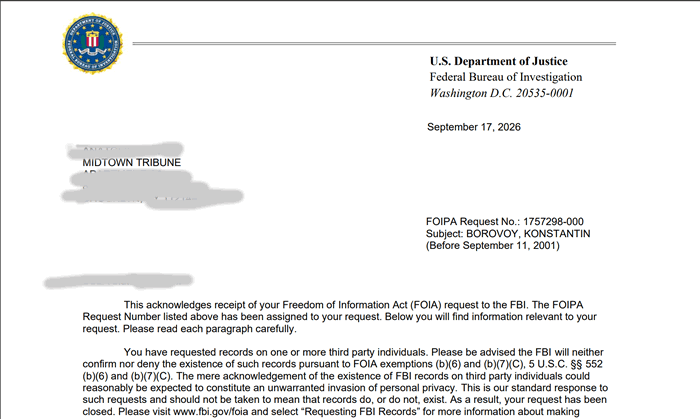
On September 17, 2026, the Federal Bureau of Investigation sent Midtown Tribune a formal response to a Freedom of Information Act request seeking records concerning Konstantin Borovoy from the period before September 11, 2001.

The FBI assigned the matter FOIPA Request No. 1757298-000 and identified the subject as:

“BOROVOY, KONSTANTIN (Before September 11, 2001)”

The FBI did not say that no records exist.

Instead, because the request concerns another living individual, the bureau said it would “neither confirm nor deny the existence of such records” under FOIA privacy exemptions (b)(6) and (b)(7)(C).

The FBI also stated that this standard response should not be interpreted to mean that records either exist or do not exist.

That distinction is central. The FBI response does not validate Borovoy’s allegations, but it also does not resolve whether responsive records exist.

Why Midtown Tribune Requested the Records

The FBI request is not the subject of the investigation. It is one tool being used to search for contemporaneous evidence.

Midtown Tribune is examining a specific historical claim: whether Borovoy provided U.S. authorities before September 11, 2001 with information alleging that Osama bin Laden and al-Qaeda were preparing an attack involving civilian aircraft and New York, and whether that information also alleged involvement or cooperation by Russian intelligence or security structures.

The investigation asks four separate questions:

  • Did Borovoy actually provide such information to U.S. officials before September 11, 2001?
  • If he did, what exactly did he say and when did he say it?
  • Did his information include a specific allegation concerning Russian intelligence or security services?
  • Do contemporaneous U.S. government records support, contradict or materially qualify his later account?

Those questions should not be collapsed into a conclusion. Proof that a warning was delivered would not automatically prove that the warning was accurate. Proof of historical Soviet relationships with militant organizations would not automatically prove Russian involvement in 9/11.

What Borovoy Publicly Claimed

In a 2020 interview published by Gordon, Borovoy was asked directly about his claim that Russian intelligence services were involved in planning an attack by Osama bin Laden’s terrorists against the United States.

Borovoy answered that he had traveled to the United States in 1999 carrying information about preparations for terrorist attacks. He described the information as alleging that bin Laden and al-Qaeda intended to use civilian aircraft against skyscrapers in New York.

He further said that he told a deputy director of the FBI in Washington about the information.

These are Borovoy’s statements, not independently established findings by Midtown Tribune.

Source: Gordon interview with Konstantin Borovoy.

Borovoy’s Claimed Source: Two GRU Officers

In the same interview, Borovoy said that the information came from two officers whom he identified as GRU officers. According to his account, those officers told him about bin Laden while he was investigating other allegations involving Russian security structures.

Borovoy also claimed that a later FBI inquiry made with the assistance of a U.S. congressman confirmed that the FBI had possessed such information but had failed to act on it because of poor coordination among agencies.

Midtown Tribune has not yet obtained the alleged 2003 FBI response described by Borovoy. Until such a document is produced and authenticated, that portion remains Borovoy’s claim.

A Contemporaneous Fact: Borovoy Was Testifying in Washington in 1999

There is independent official evidence placing Borovoy in Washington during the relevant period.

On October 7, 1999, Borovoy testified before the U.S. House Committee on International Relations at a hearing titled U.S. Policy Toward Russia, Part II: Corruption in the Russian Government.

The official congressional record identifies him as a Russian State Duma deputy and chairman of the Economic Freedom Party.

In that testimony, Borovoy warned about the criminalization of Russian political power, hostility toward the United States and NATO, and the possibility that Russia could develop into what he called a “small evil empire” hostile to the democratic world. He also warned that U.S. policy could produce circumstances resembling events preceding Pearl Harbor.

Source: U.S. Government Publishing Office — October 7, 1999 House hearing.

But the public transcript of that hearing does not contain Borovoy’s later specific claim about bin Laden, civilian aircraft striking New York skyscrapers or Russian intelligence involvement in such an operation.

That absence is important. It is one reason Midtown Tribune is seeking other contemporaneous records.

Why Midtown Tribune Is Also Examining the Soviet-Era Record

Borovoy’s allegation concerns post-Soviet Russian intelligence. Midtown Tribune is also reviewing older open-source material because some former Soviet-bloc intelligence officials described a much earlier history of state contact with militant organizations and aircraft hijacking.

This historical material may provide context. It does not by itself establish continuity from Soviet operations to the September 11 plot.

Ion Mihai Pacepa’s Claim About the KGB and Passenger Aircraft

Ion Mihai Pacepa, a former senior Romanian intelligence official who defected to the United States, later made a striking retrospective allegation about Soviet intelligence and terrorism.

Writing in 2011, Pacepa said that KGB chairman Yuri Andropov viewed international terrorism as a strategic weapon and claimed that hijacked passenger aircraft became a KGB terrorist tool beginning in 1969.

Pacepa further claimed that a series of major hijackings had been organized through KGB structures and carried out by militants trained by the KGB.

Source: Ion Mihai Pacepa, “What I Remember,” National Review, 2011.

Midtown Tribune treats this as Pacepa’s retrospective allegation. It is not equivalent to an official finding that the Soviet Union created the specific September 11 method of crashing hijacked civilian aircraft into buildings.

What Archival Records Show About the KGB and Wadi Haddad

Separate archival material provides documentary evidence of a covert relationship between the KGB and Wadi Haddad, who headed external operations for the Popular Front for the Liberation of Palestine.

A KGB memorandum dated April 23, 1974, reproduced and translated by the Bukovsky Archives, states that the KGB had maintained secret working contact with Haddad since 1968. The document says the relationship allowed Soviet intelligence to exercise influence over the PFLP’s external-operations section and potentially pursue Soviet objectives through the organization while preserving secrecy.

Source: Bukovsky Archives — KGB memorandum, April 23, 1974.

A second KGB document dated May 16, 1975, also reproduced by the Bukovsky Archives, describes Haddad as a trusted KGB intelligence agent and records a covert Soviet transfer of foreign-made weapons and ammunition to him.

Source: Bukovsky Archives — KGB memorandum, May 16, 1975.

These documents are relevant to the historical question of Soviet relationships with militant organizations. They do not establish that the KGB planned the September 11 attacks.

U.S. Government Records Confirm Earlier Terrorist Hijackings of New York-Bound Aircraft

Official U.S. records provide another part of the historical background.

On September 6, 1970, members of the PFLP launched a coordinated series of aircraft hijackings. U.S. State Department records show that TWA Flight 741 was scheduled from Frankfurt to New York and Swissair Flight 100 from Zurich to New York when they were hijacked. Other aircraft were also targeted in the operation.

Source: U.S. Department of State, Office of the Historian — September 6, 1970 telegram on multiple hijackings.

A National Archives account of the same episode describes four commercial aircraft in Europe destined for New York City as targets of the coordinated September 1970 operation.

Source: U.S. National Archives — historical review of the September 1970 hijackings.

But the 1970 operation involved hijacking, hostage-taking and destruction of aircraft after passengers were removed. These U.S. archival records do not establish a Soviet plan to crash civilian aircraft into New York skyscrapers.

What the Official 9/11 Record Says

The established U.S. account attributes the September 11 attacks to al-Qaeda.

The FBI’s official history of the investigation states that the 19 hijackers were trained by al-Qaeda and that the Bureau opened the PENTTBOM investigation immediately after the attacks.

Source: FBI — 9/11 Investigation.

The 9/11 Commission reconstructed the development of the plot within al-Qaeda, including the roles of Khalid Sheikh Mohammed and Osama bin Laden.

The Commission also reported that the available evidence showed the 19 operatives were funded by al-Qaeda and that it found no evidence that a foreign government or foreign government official supplied funding for the plot.

Source: National Commission on Terrorist Attacks Upon the United States — Chapter 5.

That finding is significant, but it should not be stretched beyond what it says. A finding concerning financing is not automatically a finding about every conceivable intelligence contact, relationship, source, warning or form of assistance.

What the Current Evidence Does — and Does Not — Show

What is documented

  • Borovoy publicly claimed that in 1999 he carried information to the United States concerning bin Laden, al-Qaeda, civilian aircraft and New York.
  • Borovoy publicly alleged that the information included a Russian-intelligence dimension.
  • Borovoy was in Washington and testified before Congress in October 1999 on Russian political and security concerns.
  • Pacepa later alleged that Soviet intelligence had adopted aircraft hijacking as a terrorist instrument decades earlier.
  • Archival KGB material reproduced by the Bukovsky Archives documents a covert KGB relationship with Wadi Haddad, a major PFLP external-operations figure.
  • Official U.S. records document PFLP hijackings of New York-bound passenger aircraft in 1970.
  • The official U.S. 9/11 record attributes the attacks to al-Qaeda.
  • The FBI has now declined to confirm or deny whether it holds responsive pre-9/11 records concerning Borovoy.

What is not established

  • Midtown Tribune has not established that the Kremlin planned the September 11 attacks.
  • Midtown Tribune has not established that Vladimir Putin personally ordered or approved the attacks.
  • Midtown Tribune has not established that Russian intelligence directed Osama bin Laden or al-Qaeda’s 9/11 operation.
  • Midtown Tribune has not established that the Soviet Union designed the specific tactic of crashing civilian passenger aircraft into New York skyscrapers.
  • Midtown Tribune has not yet obtained a contemporaneous FBI document confirming Borovoy’s claimed 1999 warning.
  • Midtown Tribune has not yet obtained the 2003 FBI response Borovoy says confirmed that the information had existed inside the U.S. government.

What the FBI’s New Letter Means

The September 17, 2026 FBI letter is important because it creates a documented new step in the records search.

It confirms that the FBI formally processed Midtown Tribune’s request under FOIPA Request No. 1757298-000 and identified its subject as “BOROVOY, KONSTANTIN (Before September 11, 2001).”

But because the request concerned a third party, the bureau invoked privacy exemptions and declined to confirm or deny whether responsive records exist.

The letter therefore cannot honestly be described as either:

  • “The FBI confirmed Borovoy’s warning,” or
  • “The FBI confirmed there are no Borovoy records.”

Neither statement is supported by the response.
Midtown Tribune Has Asked Borovoy to Request His Own Records

After receiving the FBI response, Midtown Tribune contacted Borovoy and asked him to consider filing his own first-person request for FBI records covering the period from January 1, 1999 through September 11, 2001.

The purpose is straightforward: the FBI’s current response is based on privacy protections applicable to a request concerning another person. A request from Borovoy himself could permit a different records review, although other legal exemptions could still apply.

Midtown Tribune has supplied Borovoy with draft language for such a request.

The Evidence Midtown Tribune Is Looking For

The investigation is now focused on documents created before September 11, 2001.

Particularly important would be authenticated records showing that, before the attacks, U.S. officials received information combining some or all of the following elements:

  • Osama bin Laden or al-Qaeda;
  • civilian passenger aircraft;
  • New York or New York skyscrapers;
  • a planned attack against the United States;
  • and an allegation concerning Russian intelligence or security personnel.

An FBI FD-302, electronic communication, intelligence referral, embassy cable, State Department record, congressional correspondence, visitor record or other contemporaneous government document could materially change the evidentiary picture.

Even then, two questions would remain separate:

  1. Was the warning actually delivered before September 11?
  2. Was the warning factually correct?

Those are not the same question.

The Central Question

Midtown Tribune’s investigation can be reduced to a narrowly framed historical question:

Did U.S. authorities receive a specific warning before September 11, 2001 alleging that Russian intelligence or security structures were connected to a bin Laden operation involving civilian aircraft and New York — and, if so, what evidence existed behind that warning?

That is the question the records search is intended to answer.

Bottom Line

The news today is that the FBI has responded to Midtown Tribune’s records request.

The bureau declined to confirm or deny whether it holds responsive pre-9/11 records concerning Konstantin Borovoy.

The larger investigation concerns Borovoy’s allegation that he warned U.S. officials in 1999 about bin Laden, civilian aircraft, New York and an alleged Russian-intelligence connection.

Open-source historical material shows that Soviet intelligence had covert relationships with figures involved in international terrorism and that militant organizations had used civilian passenger aircraft in coordinated operations decades before 9/11. Pacepa later alleged that aircraft hijacking had become a KGB terrorist instrument.

But those facts and allegations do not, separately or together, prove Russian responsibility for 9/11.

The missing evidence is contemporaneous documentation directly connecting the specific pre-9/11 warning described by Borovoy to U.S. government records — and, beyond that, evidence establishing whether the underlying allegation was true.

Midtown Tribune is continuing to look for that evidence.


FAQ

Did the FBI confirm that it has records about Borovoy’s alleged 1999 warning?

No. The FBI declined to confirm or deny whether responsive records exist.

Did the FBI say that no such records exist?

No. The FBI specifically said its standard response should not be interpreted to mean that records either exist or do not exist.

Is Midtown Tribune claiming that Russia organized 9/11?

No. Midtown Tribune is investigating Borovoy’s allegation and related historical evidence. The established U.S. record attributes the attacks to al-Qaeda.

What exactly did Borovoy claim?

In a 2020 interview, Borovoy said he brought information to the United States in 1999 alleging that bin Laden and al-Qaeda were preparing to use civilian aircraft against New York skyscrapers. He also described the information as having a Russian-intelligence dimension. These remain his claims unless independently corroborated.

What did Pacepa claim?

Pacepa later alleged that Soviet intelligence had turned hijacked passenger aircraft into a terrorist instrument beginning in the late 1960s. Midtown Tribune treats this as a retrospective intelligence-source claim, not proof that the Soviet Union designed the September 11 attacks.

What do archival records independently show?

Archival KGB material reproduced by the Bukovsky Archives documents covert KGB contact with Wadi Haddad of the PFLP and later Soviet arms support. Official U.S. records document coordinated PFLP hijackings of New York-bound aircraft in 1970. These records establish historical context, not responsibility for 9/11.


Primary Sources and Investigation Files

FBI — September 17, 2026 FOIPA response to Midtown Tribune
FOIPA Request No. 1757298-000, subject: “BOROVOY, KONSTANTIN (Before September 11, 2001).” Midtown Tribune possesses the response letter. The public article does not reproduce the requester’s private address or any temporary eFOIA download token.

U.S. Government Publishing Office — Borovoy testimony, October 7, 1999
U.S. Policy Toward Russia, Part II: Corruption in the Russian Government

FBI — Official 9/11 investigation
9/11 Investigation

National Commission on Terrorist Attacks Upon the United States
9/11 Commission Report — Chapter 5

U.S. Department of State, Office of the Historian
September 6, 1970 telegram on multiple aircraft hijackings

U.S. National Archives
Historical review of the September 1970 hijackings

Konstantin Borovoy interview
Gordon — Borovoy interview containing his account of the alleged 1999 warning

Ion Mihai Pacepa — retrospective account
National Review — “What I Remember”

KGB memorandum reproduced by the Bukovsky Archives — April 23, 1974
KGB contact with Wadi Haddad

KGB memorandum reproduced by the Bukovsky Archives — May 16, 1975
Covert arms transfer to Wadi Haddad


Editorial Standard

Midtown Tribune distinguishes primary documents, established historical facts, retrospective testimony and unverified allegations. Statements by Konstantin Borovoy and Ion Mihai Pacepa are attributed to them unless independently corroborated. Historical evidence of Soviet intelligence relationships with militant organizations does not, by itself, establish Soviet or Russian responsibility for the September 11 attacks. This investigation will be updated if additional authenticated primary-source records become available.

Ask Midtown Tribune about this story

Answers are grounded first in this article. Search all Midtown Tribune reporting from the main AI Search page.