NEW YORK — The FBI has formally responded to a Midtown Tribune records request concerning
Konstantin Borovoy
and the period before September 11, 2001. The bureau declined to confirm or deny whether responsive records exist. The request is part of a broader documentary investigation into Borovoy’s public claim that he warned U.S. officials in 1999 about Osama bin Laden, civilian aircraft, New York and alleged Russian intelligence involvement.
September 24, 2026 | Midtown Tribune Investigations Desk
Editorial clarification: Midtown Tribune is investigating Borovoy’s allegations and related open-source historical material. We are not reporting as established fact that the Kremlin, the Soviet Union, Russian intelligence, or Vladimir Putin planned or directed the September 11 attacks. The official U.S. record attributes the attacks to al-Qaeda. The purpose of this investigation is to determine whether contemporaneous records support, contradict or clarify Borovoy’s claims.
The New Development: The FBI Has Responded
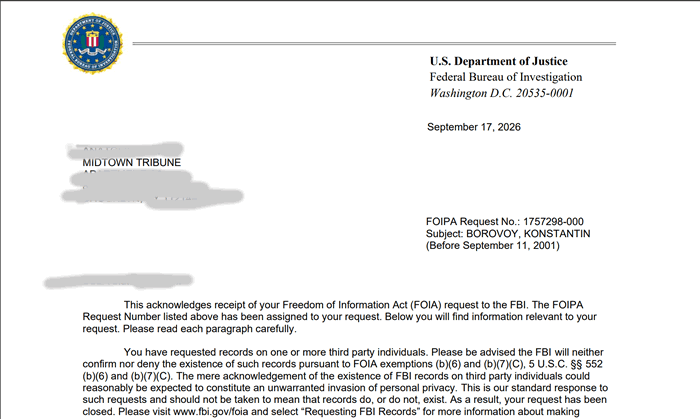
On September 17, 2026, the Federal Bureau of Investigation sent Midtown Tribune a formal response to a Freedom of Information Act request seeking records concerning Konstantin Borovoy from the period before September 11, 2001.
The FBI assigned the matter FOIPA Request No. 1757298-000 and identified the subject as:
“BOROVOY, KONSTANTIN (Before September 11, 2001)”
The FBI did not say that no records exist.
Instead, because the request concerns another living individual, the bureau said it would “neither confirm nor deny the existence of such records” under FOIA privacy exemptions (b)(6) and (b)(7)(C).
The FBI also stated that this standard response should not be interpreted to mean that records either exist or do not exist.
That distinction is central. The FBI response does not validate Borovoy’s allegations, but it also does not resolve whether responsive records exist.
Why Midtown Tribune Requested the Records
The FBI request is not the subject of the investigation. It is one tool being used to search for contemporaneous evidence.
Midtown Tribune is examining a specific historical claim: whether Borovoy provided U.S. authorities before September 11, 2001 with information alleging that Osama bin Laden and al-Qaeda were preparing an attack involving civilian aircraft and New York, and whether that information also alleged involvement or cooperation by Russian intelligence or security structures.
The investigation asks four separate questions:
- Did Borovoy actually provide such information to U.S. officials before September 11, 2001?
- If he did, what exactly did he say and when did he say it?
- Did his information include a specific allegation concerning Russian intelligence or security services?
- Do contemporaneous U.S. government records support, contradict or materially qualify his later account?
Those questions should not be collapsed into a conclusion. Proof that a warning was delivered would not automatically prove that the warning was accurate. Proof of historical Soviet relationships with militant organizations would not automatically prove Russian involvement in 9/11.
What Borovoy Publicly Claimed
In a 2020 interview published by Gordon, Borovoy was asked directly about his claim that Russian intelligence services were involved in planning an attack by Osama bin Laden’s terrorists against the United States.
Borovoy answered that he had traveled to the United States in 1999 carrying information about preparations for terrorist attacks. He described the information as alleging that bin Laden and al-Qaeda intended to use civilian aircraft against skyscrapers in New York.
He further said that he told a deputy director of the FBI in Washington about the information.
These are Borovoy’s statements, not independently established findings by Midtown Tribune.
Source: Gordon interview with Konstantin Borovoy.
Borovoy’s Claimed Source: Two GRU Officers
In the same interview, Borovoy said that the information came from two officers whom he identified as GRU officers. According to his account, those officers told him about bin Laden while he was investigating other allegations involving Russian security structures.
Borovoy also claimed that a later FBI inquiry made with the assistance of a U.S. congressman confirmed that the FBI had possessed such information but had failed to act on it because of poor coordination among agencies.
Midtown Tribune has not yet obtained the alleged 2003 FBI response described by Borovoy. Until such a document is produced and authenticated, that portion remains Borovoy’s claim.
A Contemporaneous Fact: Borovoy Was Testifying in Washington in 1999
There is independent official evidence placing Borovoy in Washington during the relevant period.
On October 7, 1999, Borovoy testified before the U.S. House Committee on International Relations at a hearing titled U.S. Policy Toward Russia, Part II: Corruption in the Russian Government.
The official congressional record identifies him as a Russian State Duma deputy and chairman of the Economic Freedom Party.
In that testimony, Borovoy warned about the criminalization of Russian political power, hostility toward the United States and NATO, and the possibility that Russia could develop into what he called a “small evil empire” hostile to the democratic world. He also warned that U.S. policy could produce circumstances resembling events preceding Pearl Harbor.
Source: U.S. Government Publishing Office — October 7, 1999 House hearing.
But the public transcript of that hearing does not contain Borovoy’s later specific claim about bin Laden, civilian aircraft striking New York skyscrapers or Russian intelligence involvement in such an operation.
That absence is important. It is one reason Midtown Tribune is seeking other contemporaneous records.
Why Midtown Tribune Is Also Examining the Soviet-Era Record
Borovoy’s allegation concerns post-Soviet Russian intelligence. Midtown Tribune is also reviewing older open-source material because some former Soviet-bloc intelligence officials described a much earlier history of state contact with militant organizations and aircraft hijacking.
This historical material may provide context. It does not by itself establish continuity from Soviet operations to the September 11 plot.
Ion Mihai Pacepa’s Claim About the KGB and Passenger Aircraft
Ion Mihai Pacepa, a former senior Romanian intelligence official who defected to the United States, later made a striking retrospective allegation about Soviet intelligence and terrorism.
Writing in 2011, Pacepa said that KGB chairman Yuri Andropov viewed international terrorism as a strategic weapon and claimed that hijacked passenger aircraft became a KGB terrorist tool beginning in 1969.
Pacepa further claimed that a series of major hijackings had been organized through KGB structures and carried out by militants trained by the KGB.
Source: Ion Mihai Pacepa, “What I Remember,” National Review, 2011.
Midtown Tribune treats this as Pacepa’s retrospective allegation. It is not equivalent to an official finding that the Soviet Union created the specific September 11 method of crashing hijacked civilian aircraft into buildings.
What Archival Records Show About the KGB and Wadi Haddad
Separate archival material provides documentary evidence of a covert relationship between the KGB and Wadi Haddad, who headed external operations for the Popular Front for the Liberation of Palestine.
A KGB memorandum dated April 23, 1974, reproduced and translated by the Bukovsky Archives, states that the KGB had maintained secret working contact with Haddad since 1968. The document says the relationship allowed Soviet intelligence to exercise influence over the PFLP’s external-operations section and potentially pursue Soviet objectives through the organization while preserving secrecy.
Source: Bukovsky Archives — KGB memorandum, April 23, 1974.
A second KGB document dated May 16, 1975, also reproduced by the Bukovsky Archives, describes Haddad as a trusted KGB intelligence agent and records a covert Soviet transfer of foreign-made weapons and ammunition to him.
Source: Bukovsky Archives — KGB memorandum, May 16, 1975.
These documents are relevant to the historical question of Soviet relationships with militant organizations. They do not establish that the KGB planned the September 11 attacks.
U.S. Government Records Confirm Earlier Terrorist Hijackings of New York-Bound Aircraft
Official U.S. records provide another part of the historical background.
On September 6, 1970, members of the PFLP launched a coordinated series of aircraft hijackings. U.S. State Department records show that TWA Flight 741 was scheduled from Frankfurt to New York and Swissair Flight 100 from Zurich to New York when they were hijacked. Other aircraft were also targeted in the operation.
Source: U.S. Department of State, Office of the Historian — September 6, 1970 telegram on multiple hijackings.
A National Archives account of the same episode describes four commercial aircraft in Europe destined for New York City as targets of the coordinated September 1970 operation.
Source: U.S. National Archives — historical review of the September 1970 hijackings.
But the 1970 operation involved hijacking, hostage-taking and destruction of aircraft after passengers were removed. These U.S. archival records do not establish a Soviet plan to crash civilian aircraft into New York skyscrapers.
What the Official 9/11 Record Says
The established U.S. account attributes the September 11 attacks to al-Qaeda.
The FBI’s official history of the investigation states that the 19 hijackers were trained by al-Qaeda and that the Bureau opened the PENTTBOM investigation immediately after the attacks.
Source: FBI — 9/11 Investigation.
The 9/11 Commission reconstructed the development of the plot within al-Qaeda, including the roles of Khalid Sheikh Mohammed and Osama bin Laden.
The Commission also reported that the available evidence showed the 19 operatives were funded by al-Qaeda and that it found no evidence that a foreign government or foreign government official supplied funding for the plot.
Source: National Commission on Terrorist Attacks Upon the United States — Chapter 5.
That finding is significant, but it should not be stretched beyond what it says. A finding concerning financing is not automatically a finding about every conceivable intelligence contact, relationship, source, warning or form of assistance.
What the Current Evidence Does — and Does Not — Show
What is documented
- Borovoy publicly claimed that in 1999 he carried information to the United States concerning bin Laden, al-Qaeda, civilian aircraft and New York.
- Borovoy publicly alleged that the information included a Russian-intelligence dimension.
- Borovoy was in Washington and testified before Congress in October 1999 on Russian political and security concerns.
- Pacepa later alleged that Soviet intelligence had adopted aircraft hijacking as a terrorist instrument decades earlier.
- Archival KGB material reproduced by the Bukovsky Archives documents a covert KGB relationship with Wadi Haddad, a major PFLP external-operations figure.
- Official U.S. records document PFLP hijackings of New York-bound passenger aircraft in 1970.
- The official U.S. 9/11 record attributes the attacks to al-Qaeda.
- The FBI has now declined to confirm or deny whether it holds responsive pre-9/11 records concerning Borovoy.
What is not established
- Midtown Tribune has not established that the Kremlin planned the September 11 attacks.
- Midtown Tribune has not established that Vladimir Putin personally ordered or approved the attacks.
- Midtown Tribune has not established that Russian intelligence directed Osama bin Laden or al-Qaeda’s 9/11 operation.
- Midtown Tribune has not established that the Soviet Union designed the specific tactic of crashing civilian passenger aircraft into New York skyscrapers.
- Midtown Tribune has not yet obtained a contemporaneous FBI document confirming Borovoy’s claimed 1999 warning.
- Midtown Tribune has not yet obtained the 2003 FBI response Borovoy says confirmed that the information had existed inside the U.S. government.
What the FBI’s New Letter Means
The September 17, 2026 FBI letter is important because it creates a documented new step in the records search.
It confirms that the FBI formally processed Midtown Tribune’s request under FOIPA Request No. 1757298-000 and identified its subject as “BOROVOY, KONSTANTIN (Before September 11, 2001).”
But because the request concerned a third party, the bureau invoked privacy exemptions and declined to confirm or deny whether responsive records exist.
The letter therefore cannot honestly be described as either:
- “The FBI confirmed Borovoy’s warning,” or
- “The FBI confirmed there are no Borovoy records.”
Neither statement is supported by the response.
Midtown Tribune Has Asked Borovoy to Request His Own Records
After receiving the FBI response, Midtown Tribune contacted Borovoy and asked him to consider filing his own first-person request for FBI records covering the period from January 1, 1999 through September 11, 2001.
The purpose is straightforward: the FBI’s current response is based on privacy protections applicable to a request concerning another person. A request from Borovoy himself could permit a different records review, although other legal exemptions could still apply.
Midtown Tribune has supplied Borovoy with draft language for such a request.
The Evidence Midtown Tribune Is Looking For
The investigation is now focused on documents created before September 11, 2001.
Particularly important would be authenticated records showing that, before the attacks, U.S. officials received information combining some or all of the following elements:
- Osama bin Laden or al-Qaeda;
- civilian passenger aircraft;
- New York or New York skyscrapers;
- a planned attack against the United States;
- and an allegation concerning Russian intelligence or security personnel.
An FBI FD-302, electronic communication, intelligence referral, embassy cable, State Department record, congressional correspondence, visitor record or other contemporaneous government document could materially change the evidentiary picture.
Even then, two questions would remain separate:
- Was the warning actually delivered before September 11?
- Was the warning factually correct?
Those are not the same question.
The Central Question
Midtown Tribune’s investigation can be reduced to a narrowly framed historical question:
Did U.S. authorities receive a specific warning before September 11, 2001 alleging that Russian intelligence or security structures were connected to a bin Laden operation involving civilian aircraft and New York — and, if so, what evidence existed behind that warning?
That is the question the records search is intended to answer.
Bottom Line
The news today is that the FBI has responded to Midtown Tribune’s records request.
The bureau declined to confirm or deny whether it holds responsive pre-9/11 records concerning Konstantin Borovoy.
The larger investigation concerns Borovoy’s allegation that he warned U.S. officials in 1999 about bin Laden, civilian aircraft, New York and an alleged Russian-intelligence connection.
Open-source historical material shows that Soviet intelligence had covert relationships with figures involved in international terrorism and that militant organizations had used civilian passenger aircraft in coordinated operations decades before 9/11. Pacepa later alleged that aircraft hijacking had become a KGB terrorist instrument.
But those facts and allegations do not, separately or together, prove Russian responsibility for 9/11.
The missing evidence is contemporaneous documentation directly connecting the specific pre-9/11 warning described by Borovoy to U.S. government records — and, beyond that, evidence establishing whether the underlying allegation was true.
Midtown Tribune is continuing to look for that evidence.
FAQ
Did the FBI confirm that it has records about Borovoy’s alleged 1999 warning?
No. The FBI declined to confirm or deny whether responsive records exist.
Did the FBI say that no such records exist?
No. The FBI specifically said its standard response should not be interpreted to mean that records either exist or do not exist.
Is Midtown Tribune claiming that Russia organized 9/11?
No. Midtown Tribune is investigating Borovoy’s allegation and related historical evidence. The established U.S. record attributes the attacks to al-Qaeda.
What exactly did Borovoy claim?
In a 2020 interview, Borovoy said he brought information to the United States in 1999 alleging that bin Laden and al-Qaeda were preparing to use civilian aircraft against New York skyscrapers. He also described the information as having a Russian-intelligence dimension. These remain his claims unless independently corroborated.
What did Pacepa claim?
Pacepa later alleged that Soviet intelligence had turned hijacked passenger aircraft into a terrorist instrument beginning in the late 1960s. Midtown Tribune treats this as a retrospective intelligence-source claim, not proof that the Soviet Union designed the September 11 attacks.
What do archival records independently show?
Archival KGB material reproduced by the Bukovsky Archives documents covert KGB contact with Wadi Haddad of the PFLP and later Soviet arms support. Official U.S. records document coordinated PFLP hijackings of New York-bound aircraft in 1970. These records establish historical context, not responsibility for 9/11.
Primary Sources and Investigation Files
FBI — September 17, 2026 FOIPA response to Midtown Tribune
FOIPA Request No. 1757298-000, subject: “BOROVOY, KONSTANTIN (Before September 11, 2001).” Midtown Tribune possesses the response letter. The public article does not reproduce the requester’s private address or any temporary eFOIA download token.
U.S. Government Publishing Office — Borovoy testimony, October 7, 1999
U.S. Policy Toward Russia, Part II: Corruption in the Russian Government
FBI — Official 9/11 investigation
9/11 Investigation
National Commission on Terrorist Attacks Upon the United States
9/11 Commission Report — Chapter 5
U.S. Department of State, Office of the Historian
September 6, 1970 telegram on multiple aircraft hijackings
U.S. National Archives
Historical review of the September 1970 hijackings
Konstantin Borovoy interview
Gordon — Borovoy interview containing his account of the alleged 1999 warning
Ion Mihai Pacepa — retrospective account
National Review — “What I Remember”
KGB memorandum reproduced by the Bukovsky Archives — April 23, 1974
KGB contact with Wadi Haddad
KGB memorandum reproduced by the Bukovsky Archives — May 16, 1975
Covert arms transfer to Wadi Haddad
Editorial Standard
Midtown Tribune distinguishes primary documents, established historical facts, retrospective testimony and unverified allegations. Statements by Konstantin Borovoy and Ion Mihai Pacepa are attributed to them unless independently corroborated. Historical evidence of Soviet intelligence relationships with militant organizations does not, by itself, establish Soviet or Russian responsibility for the September 11 attacks. This investigation will be updated if additional authenticated primary-source records become available.
Ask Midtown Tribune about this story
Answers are grounded first in this article. Search all Midtown Tribune reporting from the main AI Search page.


 Midtown Tribune.