
Trump has made his betrayal of Ukraine official and here’s what’s coming next. After the diesel deal and Starlink restrictions, Ukraine’s friends must act. My latest Next Move:
thenextmove.org/p/trump-betr…— @Kasparov63 Oct 15, 2026
Author: wawiimuy
Hebrew is the only language in human history that was fully revived from a liturgical “dead” language into the everyday native tongue of millions.
In 1881, Eliezer Ben-Yehuda arrived in Ottoman Jerusalem determined to make Hebrew spoken again. He and his wife created the first modern Hebrew-speaking household. Their son, Itamar Ben-Avi, became the first native speaker of modern Hebrew in centuries. Ben-Yehuda also built a massive dictionary and coined hundreds of new words for modern life.
By 1922 the British Mandate recognized Hebrew as an official language.
Today more than 9 million people speak it daily.
Eliezer Ben-Yehuda
— @jewishhistoryst Oct 15, 2026
“The United States has chosen the wrong side of history.”
President Zelenskyy
— @rshereme Oct 14, 2026
9/11 attacks investigations: approaches and hypotheses
Investigations into the September 11, 2001, terrorist attacks have relied on distinct official, academic, and alternative investigative approaches, evaluating several core hypotheses regarding who was responsible, how the security breakdown occurred, and whether the hijackers received external state support.1. Official Government and Forensic Investigations
The primary official approach relied on bipartisan congressional mandates, criminal forensics, and specialized engineering analyses to establish the definitive timeline and mechanism of the attacks.
The 9/11 Commission Approach: Established by Congress and President George W. Bush in late 2002, the National Commission on Terrorist Attacks Upon the United States focused on intelligence integration, homeland defense, and institutional preparedness. Its approach relied on reviewing sensitive intelligence, interviewing hundreds of witnesses, and examining counterterrorism policies across federal agencies. [1]
The FBI’s PENTTBOM Investigation: The FBI launched its largest-ever historical inquiry, codenamed PENTTBOM. Operating out of FBI Headquarters, thousands of agents tracked global leads to quickly identify the 19 hijackers and trace their financial transactions and logistical footprints. [1]
The NIST Structural Forensic Approach: The National Institute of Standards and Technology (NIST) conducted an engineering-focused investigation. Their approach relied on structural models, physics simulations, and recovered debris to examine how the kinetic impact of the aircraft and subsequent jet-fuel fires compromised the infrastructure, ultimately attributing the collapse of the Twin Towers and 7 World Trade Center to these fires and impacts. [1, 2]2. Hypotheses Evaluated by Investigators
Investigators tested several major hypotheses concerning the execution and support network of the plot.
The Al-Qaeda Operational Hypothesis (Confirmed Consensus): The core hypothesis validated by the 9/11 Commission Report and international intelligence is that 19 operatives from the Salafi-Jihadi group al-Qaeda, directed by Osama bin Laden, carried out a coordinated suicide plot. This hypothesis was corroborated by extensive financial trails, communication logs, and martyrdom videos. [1, 2]
The Systemic Intelligence Failure Hypothesis: This approach explored why the U.S. intelligence community failed to disrupt the plot. Investigations exposed massive institutional deficits, including an inadequate analytical pool, a lack of clear threat dissemination guidance, and poor information-sharing between the CIA and FBI regarding operatives already inside the U.S.. [1]
The External Support and Foreign Government Liaison Hypothesis: A long-running area of active investigation concerns whether the hijackers had an active support network inside the United States, specifically examining links to foreign state nationals. For instance, civil lawsuits brought by 9/11 families have scrutinized individuals like Saudi national Omar Albayumi, who assisted two hijackers with housing and bank accounts. While early commission findings downplayed his involvement, subsequent disclosures—including pre-operational video surveillance of the U.S. Capitol and pilot descent formulas seized from an associate’s apartment—have kept open the hypothesis that the hijackers relied on local facilitators. [1, 2]3. Alternative and Non-Consensus Hypotheses
A disparate community known as the 9/11 Truth Movement rejects the official findings, proposing alternate hypotheses that have been uniformly dismissed by the scientific and investigative consensus. [1, 2]
LIHOP (Let It Happen On Purpose): This hypothesis claims that elements within the United States government possessed specific, actionable advance intelligence about the attacks but intentionally permitted them to happen to justify geopolitical military expansion.
MIHOP (Made It Happen On Purpose): This hypothesis posits that the attacks were a “false flag” operation actively planned and orchestrated by inside elements within the U.S. security apparatus.
Controlled Demolition Theory: Adherents to this theory argue that the structural damage from plane impacts and fires was insufficient to cause the symmetrical collapse of the buildings, claiming instead that explosives or incendiaries were pre-planted in the World Trade Center towers. Peer-reviewed structural engineering bodies and NIST heavily documented the physical progression of the thermal-structural collapses to refute this. [1, 2]– Google Search google.com/search?q=9%2F11+a…
— Michael Novakhov (@mikenov) Oct 14, 2026
⛔️Major developments ‼️
⛔️ Former head of Israel’s Shin Bet, Ronan Bar, filed a law suit against wanted war criminal Netanyahu, alleging the latter had received no less than twenty warnings of the precise character and of the approximate date of the Hamas attack.
⛔️Formerly, nine warnings were cited in YNet, Ha’aretz and Maariv. It has now become increasingly unreasonable not to suppose that Netanyahu was a complicit actor in the Hamas attack, an organisation he had funded, directly and indirectly, for almost twenty years, and about which he possessed precise internal intelligence.
⛔️Thus Netanyahu could not only have prevented the attack, but now appears to have been proactively enabling the attack, to manufacture a pretext to ethnically cleanse Gaza, while simultaneously using the attack to disrupt charges supported by three hundred witnesses that Netanyahu had presided over a twenty year reign of corruption, gangster-like coercion, malfeasance and repeated breaches of international law.‼️
— @drhossamsamy65 Oct 14, 2026
9/11 attacks investigations: approaches and hypotheses – Google Search google.com/search?q=9%2F11+a…
— Michael Novakhov (@mikenov) Oct 14, 2026
9/11 attacks investigations: approaches and hypotheses – Google Search google.com/search?q=9%2F11+a…
— Michael Novakhov (@mikenov) Oct 14, 2026
Pope Leo XIV thanked fellow Catholics for their prayers in his first message since he underwent surgery for lung cancer in Rome. cnn.it/4s4YaiR
— @CNN Oct 14, 2026
BIG | 🇺🇦🇺🇸🇪🇺‼️ Former U.S. Army Europe commander General Ben Hodges says European allies can provide Ukraine with intelligence to warn of incoming Russian ballistic missile attacks, even without relying exclusively on Washington.
Hodges emphasized that a significant portion of the intelligence used by the United States originates from its allies. According to him, France, Germany, the United Kingdom, Poland and Finland possess capabilities that could help Ukraine receive advance warnings of ballistic missile launches. He argued that the central obstacle is not necessarily technological capability but political willingness to share the information.
🔥 Hodges’ assessment highlights an important option for strengthening Ukraine’s security if American intelligence cooperation becomes less reliable. Greater European intelligence coordination could reduce Kyiv’s dependence on Washington and improve warning capabilities against Russian missile attacks. However, effective early warning also depends on how quickly intelligence can be processed and delivered to Ukrainian air defenses.
See the latest updates with us: @NSTRIKE1231
Video
— @NSTRIKE1231 Oct 14, 2026
 |
Michael_Novakhov shared this story . |
Former German intelligence chief August Hanning is accused of treason and spying for a foreign agency after allegedly obtaining about 2,000 classified BND documents and using them in dealings with intelligence officials from an unnamed foreign country.
Berlin has not publicly named the recipient, but emails obtained by The Cradle reveal a relationship between Hanning and former Mossad director Danny Yatom.
August Hanning headed the BND from 1998 to 2005. He was arrested on 6 October on suspicion of espionage-related offenses.
Prosecutors allege that Hanning obtained sensitive documents from Manfred D., a former BND employee. The documents reportedly included internal briefings prepared for senior German officials.
The case has revealed how vulnerable Germany’s intelligence apparatus is to people who exploit their official positions and personal networks for private gain.
Emails between Hanning and Yatom provide a glimpse into those networks
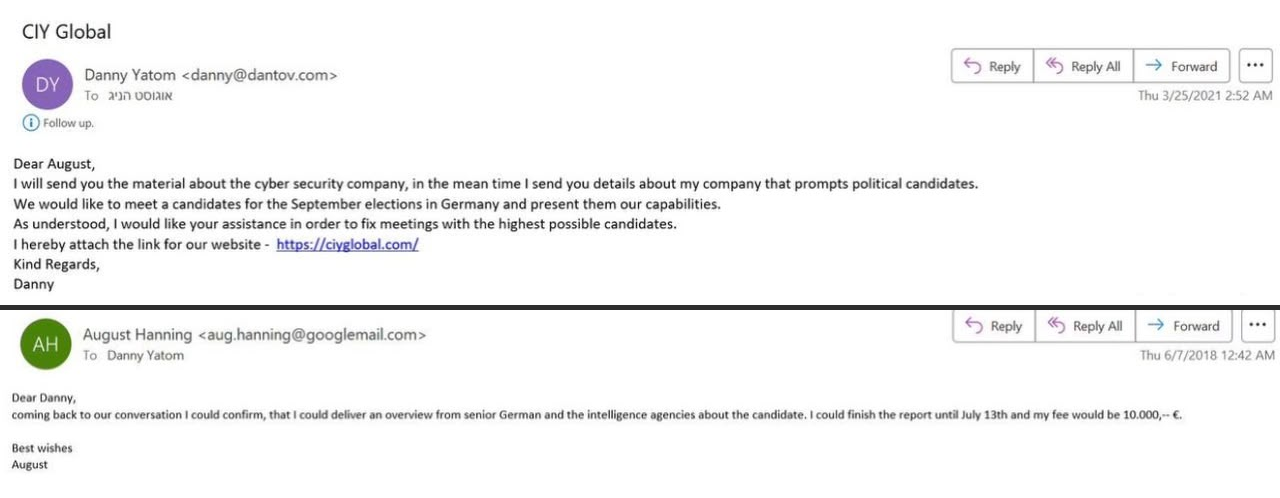
In 2018, Hanning told Yatom he could provide “an overview from senior German and the intelligence agencies about the candidate.” He offered to complete the report by 13 July for €10,000.
The email does not name the candidate, but the exchange sheds light on the nature of the relationship.
Three years later, Yatom approached Hanning about arranging meetings with senior candidates in Germany’s September 2021 federal election.
The former Mossad chief wanted to show the candidates what his “political-campaign company”, CIY Global, could do. In the same email, he mentioned material he planned to send about a cybersecurity firm.
Although the emails concern separate matters, together they reveal the relationship: Hanning offered access to German intelligence and political circles, while Yatom built businesses around political influence and cybersecurity.
These were not two former officials who had simply gone their separate ways after leaving public service. Their correspondence reveals an ongoing relationship where intelligence contacts and commercial ambitions intersected.
Their business ties extended beyond political campaigning. Yatom was linked to World Health Energy Holdings, a cybersecurity company where Hanning reportedly served on the advisory side.
The shadow network connected a former BND chief and a Mossad director through businesses where access to sensitive information and political decision-makers can be highly lucrative.
Israel has built a global market for surveillance, cyber-intelligence and political influence, partly staffed by intelligence veterans. These firms give capabilities developed in intelligence commercial cover and international reach.
Across Europe, impacts are evident. On 12 October, Polish prosecutors said data collected by the Pegasus spyware had been sent abroad and that Israel’s NSO Group retained technical access to parts of the system.
Under Poland’s previous government, Pegasus targeted political opponents and others, exposing the risks of letting an Israeli company access infrastructure used to collect highly sensitive political and personal data.
In Spain, the 2022 CatalanGate investigation documented at least 65 people connected to Catalan politics and civil society who were targeted or infected with Pegasus or Candiru spyware.
Those affected included politicians, lawyers, and civil society figures. Researchers at the University of Toronto’s Citizen Lab found strong circumstantial evidence linking the campaign to Spanish authorities.
Greece’s surveillance scandal involved targeting journalist Thanasis Koukakis and European Parliament member Nikos Androulakis, along with the use of Predator spyware linked to Intellexa, a company founded by former Israeli intelligence operative Tal Dilian.
Across these cases, surveillance tools from Israeli-linked firms targeted people whose work and politics challenged those in power.
Israel has established itself as one of the world’s leading exporters of technologies for penetrating phones, monitoring political opponents and obtaining information that would otherwise remain private, while former intelligence personnel have turned their experience into profitable international businesses.
The Hanning affair raises the possibility that this same world of intelligence veterans, private ventures, and political access also played a role in handling Germany’s state secrets.
The 2018 email shows Hanning offering intelligence-related reporting to Yatom for a fee.
The 2021 email shows Yatom seeking Hanning’s help reaching senior German political candidates.
Their cybersecurity business ties add another layer to the relationship. These facts do not establish where the documents at the centre of the espionage case ultimately went, but they give German investigators a concrete reason to examine whether interests linked to Israeli intelligence were involved.